
This article is for educational purposes only and does not constitute financial or legal advice. Consult a financial advisor, accountant, or attorney before making decisions about business financing, loans, or your business's legal structure.
TL;DR
A coffee shop business plan is a written document that covers your concept, your market, your costs, and how the shop turns a profit.
It has seven core sections: executive summary, company description, management profile, market analysis, menu and operations plan, marketing strategy, and financial projections.
Lenders read the executive summary and financial projections first, so both need to be specific and backed by real numbers.
Your market analysis has to prove local demand, not just point to a growing coffee industry.
Even self-funded owners need a plan, because it tells you your startup costs, your pricing, and your break-even point before you spend a dollar.
Start by picking your format and location, since almost every cost and projection flows from those two choices.
What is a coffee shop business plan?
A coffee shop business plan is a written document that explains what your shop will be, who it will serve, how you'll run it, and how you'll turn a profit.
Think of it as your whole coffee shop concept on paper, from your target market to your first year of sales, divided into two roles. First, it gives lenders and investors the proof of viability they need before they hand over money. Second, it gives you a clear operating roadmap for your first 12 to 18 months, so you know what to do after the doors open.
A template gives you a useful starting structure, but lenders can spot a generic plan instantly, so keep every section specific to your shop. Most plans run 15 to 25 pages, including the financial appendices at the back.
Why your business plan is essential (even if you're self-funding)
Plenty of first-time coffee shop owners think a business plan is just paperwork for the bank. It's more useful than that. Even if the money is yours, the plan is your first honest look at whether the shop can pay for itself.
A business plan should be created before opening to identify things like:
How many cups you need to sell each day to break even
How to price your drinks and food for a healthy margin
When the shop can realistically turn a profit
Owners who skip this step tend to learn those answers the hard way, and by then, the money is already gone.
The SBA recommends a business plan for every owner before opening day, no matter where the funding comes from. Whether you use savings, a loan, or both, the plan is your proof that the idea can pay off.
The 7 sections of a coffee shop business plan
Most lenders, along with the SBA, expect a standard business plan structure, which not only results in a clear path, but also speeds up the approval process. If you ignore the general structure, it may raise doubts about how carefully you've prepared.
Here are the seven sections every coffee shop business plan should include, covered one at a time.
1. Executive summary
The executive summary is written last but read first. It distills the entire plan into a snapshot of one to two pages that a lender can absorb in a few minutes.
A strong summary answers the following at a glance:
Your shop's name and concept in a single sentence
Your mission statement in about two sentences
The funding you're requesting and how you'll use it
Your headline financial projections, like your year-one revenue target and expected break-even timeline
Many lenders decide whether to keep reading based on this section alone. Make it specific and grounded in numbers. Think of it as your argument for why the coffee shop concept deserves their money, in as few words as possible.
2. Company description
The company description paints a clear picture of the shop itself. It's where you move from idea to specifics, and lenders read it to understand exactly what they'd be funding.
Cover the essentials:
Your legal structure, which for most coffee shops is a limited liability company (LLC)
Your proposed location and the leasing arrangement
The physical format of the shop, whether that's a sit-down café, a drive-thru, or a kiosk
Your concept and brand identity
Specificity separates a credible plan from a generic template. "Specialty coffee for an underserved neighborhood" gives a lender something tangible. "A welcoming café for everyone" tells them nothing.
3. Management profile
Lenders invest in people just as much as concepts. This section shows them who's running the shop and why that person can pull it off.
Summarize the owner's background and any experience that applies: hospitality, finance, retail, or operations. If you've hired or plan to hire a small management team, introduce them here too and explain what each person brings.
No direct coffee experience? Focus on transferable skills and name the advisors, mentors, or consultants backing you. One resource many first-time owners lean on is SCORE (Service Corps of Retired Executives), which offers free business plan reviews and mentorship. Listing those mentors shows lenders you're drawing on real experience, not learning everything as you go.
4. Market analysis
The market analysis proves you understand your local opportunity, not just the coffee industry in general. Lenders want evidence that real demand exists on the specific corner where you plan to open.
Build this section around your trade area, which for a coffee shop usually falls within a one to three-mile radius. Cover three things:
Local coffee demand and the demographics of the people in that radius
A competitive analysis of nearby coffee shops and substitutes like smoothie bars, fast-casual spots, and convenience stores
The specific gap your shop fills
The category itself is strong and still growing. In Technomic's 2026 America's Favorite Chains report, three coffee brands landed in the Top 10 for the first time, with fast-growing drive-thru concepts leading the way.
Macro data like that sets the backdrop, but the most convincing market analysis pairs it with hyper-local detail: foot traffic, daytime population, nearby employers, and residential density. That combination is what turns broad market research into a case for your particular location.
5. Menu and operations plan
This section shows lenders you've thought past the concept and into the daily reality of running the shop.
The menu portion covers your product categories (espresso drinks, brewed coffee, food, and retail bags of coffee beans), your pricing, your estimated cost per item, and your supplier relationships. The operations portion covers how the shop runs day to day: your staffing model, opening and closing procedures, your equipment (including the espresso machine at the center of it), your point-of-sale (POS) system, and your approach to inventory management.
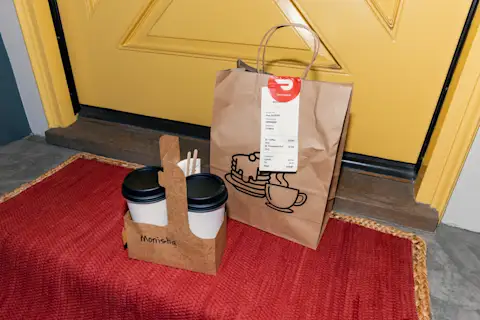
Menu clarity can also support online ordering over time. According to the 2026 DoorDash and SevenRooms Restaurant Industry Trends Report, 93% of consumers have chosen items on delivery apps because of detailed, appealing descriptions. A clean, well-organized menu can help customers understand your offerings and decide what to order.
6. Marketing strategy
Here, you’ll identify how you’ll build a customer base from the day you open. It showcases:
Your unique selling proposition (what makes customers pick your shop over the one down the street)
Your target audience (their demographics, lifestyle, and visiting habits)
Specific tactics you'll use to drive awareness and first visits
Don’t forget about digital channels. According to the same 2026 DoorDash and SevenRooms Restaurant Industry Trends Report, 37% of consumers discover restaurants through delivery apps. A DoorDash Marketplace listing can be one way to reach local customers who are already browsing for food and drinks. Consider it one part of a broader marketing mix alongside your Google Business Profile, social media, and local outreach.
7. Financial projections
For many lenders, this is the section that decides the outcome, so treat it as the financial backbone of your entire plan.
It needs these core documents:
A cash flow statement showing monthly income and expenses, your initial investment, and your ending cash position. It answers the blunt question every lender asks: can this shop pay its bills?
An income statement (profit and loss) covering projected annual sales, cost of goods sold (what you paid for the ingredients and materials in each drink or dish), and operating expenses (rent, payroll, utilities, and other costs of running the shop day to day)
A balance sheet listing your assets, liabilities, and owner's equity at a single point in time.
Project at least 12 months of cash flow, include a break-even analysis, and build in a realistic ramp. Most coffee shops take three to nine months to reach full sales volume, so revenue projections that show a packed house from week one will cost you credibility.
One benchmark to plan against: lenders generally like to see enough liquid assets to cover at least six months of operating expenses. Strong coffee shop business plan financials aren't there just to satisfy a potential lender. They also give you the numbers you'll use to run the business once you open.
How much does it cost to open a coffee shop?
Startup costs vary widely by format. As a rough guide, a kiosk or coffee cart tends to fall in the low tens of thousands, while a full sit-down café can run anywhere from around $80,000 into the mid–six figures, depending on your location, buildout, and equipment. Treat those as ballpark figures and build your own numbers from real local quotes.
The major cost categories include:
Leasehold improvements and renovations to the space
A commercial espresso machine and grinders
Refrigeration and prep equipment
Furniture and fixtures
Your POS system
Initial inventory
Licenses and permits, including your business license
A working capital reserve (cash set aside to cover expenses before the shop turns a steady profit)
Itemize every one of these in your financial section, then build in a contingency of 10% to 15%, since equipment lead times and permit delays routinely push buildout costs above the first estimate.

How to fund your coffee shop
Match your funding approach to the numbers in your financial section. New coffee shop owners should consider:
Personal savings. The most common starting point. The SBA notes that self-funding lets you keep full ownership and control, though you shoulder all the financial risk yourself.
SBA 7(a) loans. The SBA's primary business loan program, with loan amounts up to $5 million. You'll need a business plan, financial projections, and a personal credit history. The SBA guarantees part of the loan, which lowers the risk for the lender (SBA 7(a) loans).
SBA Microloans. For smaller needs, the SBA Microloan program offers loans up to $50,000, averaging around $13,000, with interest rates generally between 8% and 13% and repayment terms up to seven years. These often suit first-time owners with limited collateral (assets like property or equipment a lender could claim if the loan isn't repaid).
Friends and family. Informal but common. Put any arrangement in writing, even with people you trust.
Investors. Equity investors give you capital in exchange for partial ownership, which fits shops with a strong growth concept.
Whatever route you choose, the plan is your proof. No lender, and no serious investor, moves forward without one.
Common mistakes to avoid in your coffee shop business plan
Lenders read hundreds of plans, and most rejections trace back to the same handful of avoidable errors. Steer clear of these five:
Rushing the market analysis. A plan that fails to show real local demand draws a rejection faster than almost anything else. Ground your foot traffic estimates and competitor gaps in actual research, not assumptions.
Underestimating startup costs. Equipment delays, permit timelines, and buildout overruns are the norm, not the exception. Best-case numbers on every line item cost you credibility with a lender.
Projecting revenue without a model. "We'll serve 200 customers a day" says nothing on its own. Show how you reached that figure using seat count, average ticket, table turns, and seasonal swings.
Ignoring the first 90 days. Most coffee shops ramp up slowly. A cash flow model that shows strong revenue from month one tells a lender you haven't planned for the soft opening period.
Writing a generic plan. A plan that could describe any coffee shop in any city is an easy decline. Tie every section to your specific location, concept, and customer.
Grow your coffee shop with DoorDash Marketplace
A strong plan should account for how you’ll reach customers after opening day. DoorDash Marketplace can be one channel to include in that plan, helping you connect with local customers who are already ordering online. As orders come in, that activity may also help inform future decisions around your menu, hours, and marketing approach.