If you just heard someone shout "all day" across a busy kitchen — in person, on your first shift, or on a restaurant-set TV drama — you're not alone in wondering what it means. It's one of the most common pieces of kitchen slang, and once you know it, you'll hear it everywhere. This article breaks down the definition, why chefs rely on it, and how it's different from similar-sounding calls like "on the fly" or "86."
Quick Answer
"All day" means the total number of a specific menu item needed across every open order right now, not the total for the whole shift.
Example: if three separate order tickets each call for one burger, the expo calls out "three burgers, all day."
It's a live, running count that changes as new order tickets come in and dishes go out.
The term likely comes from military and diner kitchen slang, where callouts kept teams moving fast under pressure.
It's different from "on the fly," which flags a single rush order, not a running total.
Kitchen staff use it because one clear number is faster and less confusing than repeating several separate orders out loud.
What Does "All Day" Mean in a Restaurant Kitchen?
In restaurant kitchens, "all day" is the running total of a specific dish needed across every active order at that moment. It is not the number of that dish sold for the entire day. Unlike à la minute cooking, which times a single dish to one ticket, "all day" tracks a running total across many. The phrase keeps line cooks focused on what's needed right now, not what already went out to the dining room.
Here's a simple example. Say three separate tables order the same entree within a few minutes of each other. Instead of calling each ticket out one at a time, the expo combines them into a single number: "three chicken sandwiches, all day." That one callout tells the kitchen team exactly how many need to hit the pass.
This matters most when you're new to a professional kitchen and still learning the kitchen lingo. Once you understand that "all day" is a live count, not a daily total, the rest of the restaurant lingo around it starts to make a lot more sense. Whether you're working in a fine-dining kitchen or a fast-casual spot serving entrees over the counter, the same rule applies.
Why Do Chefs Say "All Day"?
So why do chefs say "all day" instead of just reading off each ticket? The short answer: it turns several separate orders into one clear, fast callout, which cuts down on mistakes during a rush.
It saves time. In a commercial kitchen moving at full speed, repeating four individual orders takes longer than saying one combined number. It reduces errors. When everyone on the line hears the same total at the same time, there's less room for a dish to get missed or duplicated. It trains new hires faster. A restaurant manager who wants their kitchen staff speaking the same kitchen communication doesn't have to reinvent a system — "all day" already does the job, and a quick "yes, chef" from the team confirms it landed.
It also helps prevent dead plates — dishes made too early that sit at the pass and lose quality before a server can run them to the table.
"All Day" and the Other Core Kitchen Calls
"All day" doesn't work alone — it's part of a small, learnable system of kitchen slang that keeps restaurant operations and kitchen operations moving. A few other calls worth knowing: "fire," which tells line cooks to start cooking a dish right now, "on the fly," which flags one specific order that needs to move ahead of everything else, and "corner," a quick heads-up called out when someone's rounding a tight aisle in the kitchen.
Together, these calls cover most of what a busy kitchen needs to communicate in the middle of service. You don't need a 64-term glossary to sound like you know what you're doing on the line, these cover the basics almost every commercial kitchen relies on.
"All Day" in Action: A Real Kitchen Scenario
Picture a Friday night dinner rush at a full-service restaurant, the kind of professional kitchen where front of house and back-of-house move like one team. By the time the rush hits, the kitchen team is well past mise en place and moving at full speed. Servers and other wait staff are dropping order tickets, sometimes still called chits, at the pass faster than the kitchen can glance at them.
Hosts keep seating new tables as the dining room climbs toward a hundred covers for the night, and the walk-in door hasn't stopped swinging. Within a five-minute stretch, four different tables order the same pasta dish. Rather than calling each ticket separately, the expo scans the board and calls out: "four pastas, all day."
The sous chef on that station repeats it back, plates start moving, and no ticket gets lost in the shuffle — even with the dining room in the weeds. Even the dishwashers feel the pace, clearing plates fast enough to keep pans moving on the line.
That single callout is the whole point of the system: one number, heard once, understood by the entire kitchen team without anyone stopping to ask questions.
Keeping "All Day" Accurate as Order Channels Grow
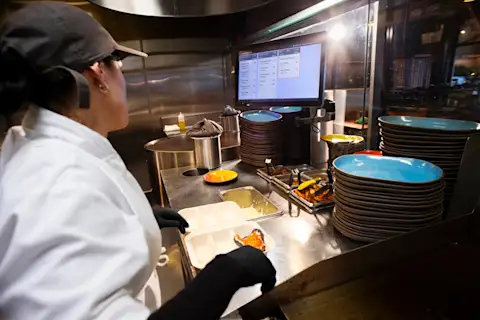
Kitchen calls like "all day" were built for a dining room full of servers dropping paper tickets. Most restaurants today take orders from a lot more places than that. Pickup and delivery tickets now land at the pass right alongside dine-in orders, and the kitchen still needs one accurate "all day" number across all of them.
That's where modern restaurant order management tools and kitchen display systems come in. When every channel feeds into the same view, the expo can still call an accurate total without manually tracking tickets from three different places.
DoorDash Marketplace is the platform where new pickup and delivery customers discover and order from a restaurant. Keeping those Marketplace tickets visible alongside dine-in orders, instead of on a separate screen, helps kitchen staff stay accurate on their "all day" counts, even during a packed rush.
Ready to Handle More Orders "All Day"?
A well-run kitchen depends on clear communication — and that gets even more important as more of your orders come from outside your dining room. Keeping your whole team, and every order channel, speaking the same language during a rush protects both your restaurant operations and your guests' experience.
DoorDash Marketplace helps restaurants reach new pickup and delivery customers, and it's often the first step toward adding tools like Online Ordering down the line.
Grow Your Restaurant with DoorDash Marketplace
Frequently Asked Questions
Why do they say "all day" in a kitchen?
Chefs say "all day" because it turns several separate order tickets for the same dish into one clear, fast number. It's faster to call out once and easier for the whole kitchen team to track than repeating each order individually.
What does it mean when a number comes before "all day" (like "3 all day" or "4 all day")?
The number is simply the live count of that dish needed right now. It's not a separate term. "Three all day" means three of that item are currently needed across all open orders.
Who calls out "all day" in a kitchen?
The expo, sometimes called the expediter or expeditor, usually calls "all day," since that role sits at the pass and tracks every ticket coming in from the dining room and other order channels. In smaller kitchens, the head chef or executive chef may call it instead.
What's the difference between "all day" and "on the fly"?
"All day" is a running total of one dish across every open order. "On the fly" flags a single, specific order that needs to move ahead of everything else, usually because a table is waiting or a ticket got missed.
Is "all day" still relevant with modern POS and kitchen display systems?
Yes. Even with a point-of-sale (POS) system and digital kitchen display systems tracking order tickets automatically, kitchens still rely on "all day" as a spoken callout. Digital systems support the count. They don't replace the communication.
Can small restaurants benefit from using "all day"?
Yes. Any restaurant with more than one cook on the line can benefit from a shared shorthand like "all day." It helps a small team stay coordinated during prep work and service without needing a big back-of-house staff to make it work. Restaurant managers often use it to train new hires faster, without re-explaining kitchen lingo every shift.