The coffee shop segment keeps growing even in a crowded market. As of May 2026, employment at coffee, donut, and ice cream shops sat 28% above pre-pandemic levels, according to the National Restaurant Association. That means there's real room for new independent shops willing to plan carefully.
This guide walks through how to open a coffee shop in the order you should actually tackle it: business plan, location, licenses and permits, startup costs, equipment, staffing, menu, and marketing. By the end, you'll know exactly what stands between you and your grand opening.
TL;DR: Steps to Open a Coffee Shop
Write a coffee shop business plan before you sign a lease or buy equipment.
Choose a location with strong foot traffic and the right demographics for your concept.
Handle your business structure, licenses and permits, and insurance early, since processing takes time.
Calculate startup costs and financing options before committing to a budget you can't support.
Invest in core equipment and a point of sale (POS) system that connects to delivery.
Hire and train your team, then build a menu and marketing plan that stand out.
The single most important action: write your business plan and budget first, before signing a lease.
Step 1: Write a Coffee Shop Business Plan
A coffee shop business plan turns a long list of steps into an ordered roadmap. Instead of guessing what to do next, you'll have a document that maps out your concept, costs, and goals. Most lenders and investors also expect one before they'll talk numbers with you.
A solid coffee shop business plan typically covers seven parts:
Executive summary — a short overview of your coffee shop concept and goals
Company overview — your business structure, ownership, and mission
Market analysis — research on your target market, demographics, and competitor analysis
Operational plan — daily workflow, staffing, and supplier relationships
Marketing plan — how you'll reach your target market and build early buzz
Financial plan — startup costs, cash flow projections, and financial projections for year one
Sample menu — a preview of your menu options and pricing strategy
If you want a head start, our step-by-step business plan guide walks through each section with a free template. For outside guidance, the U.S. Small Business Administration also offers free business plan templates built for small businesses like yours (sba.gov).
Step 2: Choose the Right Location
Your location can make or break your coffee shop, even with a great menu and strong branding. Four factors matter most when you're evaluating a spot.
Foot traffic. Look for areas where people naturally pass by throughout the day, like near offices, transit stops, or busy sidewalks.
Local demographics. Match your concept to the neighborhood — a fast, grab-and-go bar suits a commuter area, while a slower, seated cafe business fits a residential street.
Competitor analysis. Study nearby coffee shops to understand what's already being offered and where the gaps are.
Lease terms. Read the fine print on rent increases, buildout allowances, and how long you're locked in.
For a deeper walkthrough of these factors, see our location strategy guide.
Step 3: Handle Licenses, Permits, and Legal Setup
Confusion about licenses and permits is one of the most common reasons new owners fall behind schedule. Getting this step right early keeps your timeline on track.
Choose a Business Structure
Most small coffee shops choose between three common structures: a sole proprietorship, a limited liability company (LLC), or a corporation. Each option affects your personal liability and how your business is taxed. Because the right choice depends on your specific situation, it's worth consulting an accountant or attorney before you file anything.
Get Your Licenses and Permits
Most coffee shops need the same core set of licenses and permits regardless of state. Here's what to expect:
A business license from your city or county
An employer identification number (EIN) from the IRS
A certificate of occupancy for your space
A food service license
Food handler's permits for you and your staff
A health department inspection before opening
General liability and property insurance to protect your business
Processing time for licenses and permits varies widely by city and county. Start this step early, not right before your planned opening date.
*This article is for educational purposes only and does not constitute legal or financial advice. Consult an attorney or accountant before choosing a business structure or applying for licenses and permits.
Step 4: Calculate Startup Costs and Financing
Underestimating startup costs is one of the fastest ways to run out of cash before, or shortly after, opening. Budget carefully across every major category before you commit to a number.
Coffee shop startup costs typically span six areas: buildout and lease costs, equipment, licensing and permits, initial inventory, staffing, and marketing. These costs vary enormously by concept and city, so a small kiosk and a full sit-down cafe business will land in very different ranges. Rather than relying on a single universal figure, use the U.S. Small Business Administration's free startup cost calculator to build your own estimate (sba.gov).
Once you have a number, think through your financing options. Common paths include personal savings, small business loans, investors, and crowdfunding. Existing DoorDash merchants may also qualify for a merchant cash advance through DoorDash Capital, a sales-based advance with a one-time fee. Each option carries different tradeoffs, which we cover in more depth in our separate financing guide.
Step 5: Invest in Equipment and Technology
Equipment and technology decisions shape your daily workflow for years, so it's worth getting the list and layout right from the start.
Core Coffee Shop Equipment
Every coffee shop needs a core equipment list to run smoothly:
Espresso machine
Coffee brewers
Grinders
Coffee roaster (if you plan to roast your own coffee beans)
Refrigerators
Ice maker
Blenders
Dishwasher
Point of sale (POS) system
Dishware, furniture, and seating
When you're planning your interior design and kitchen layout, prioritize simplicity, workflow, and easy maintenance. A tight, efficient layout helps your team move faster during rush periods and cuts down on wasted steps.
Choose a POS System
A restaurant point of sale (POS) system is the checkout and order-management setup your baristas use to ring up drinks and track sales. Choose one with delivery integration in mind from the start, so orders from DoorDash Marketplace flow into the same system as your in-store orders instead of requiring a separate tablet. A connected POS system also makes it possible to start taking delivery orders on day one without adding extra operational complexity — helpful for a brand-new shop.
Step 6: Hire and Train Your Team
Staffing on a tight budget is one of the biggest sources of uncertainty for new owners, but a small coffee shop doesn't need a large team to start.
Most new shops begin with baristas and a shift lead or manager to oversee daily operations. When training your team, prioritize drink consistency, customer service, and health and safety procedures. Most new hires don't need prior coffee experience if they're trained well from day one.
For budgeting purposes, the U.S. Bureau of Labor Statistics tracks national wage data for food and beverage service roles, which can help you benchmark starting pay by region. As of May 2025, fast food and counter workers — the closest tracked role to a barista position — earned a mean hourly wage of $15.46, or about $32,150 per year, nationally (bls.gov). Check the linked BLS page for the most current figures, since this data updates annually.
Step 7: Build a Menu That Stands Out
Your menu is where your coffee shop concept comes to life for customers. A few choices can set your specialty coffee menu apart from the competition.
Focus on a handful of signature specialty coffee drinks that reflect your brand, rather than trying to cover every possible option. Offer clear dietary preference options, like oat or almond milk, so more customers can order with confidence. Consider sustainable packaging, since more customers are paying attention to how their order is packaged. Finally, give your menu one fun, signature twist that customers can't easily find elsewhere.
Step 8: Market Your Coffee Shop Effectively
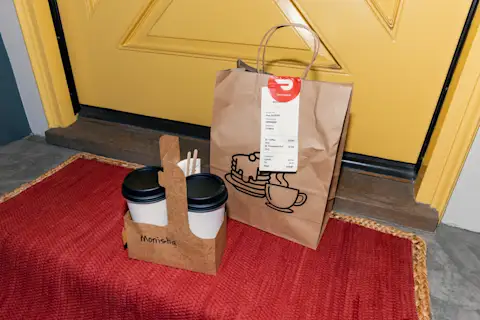
Without a storefront's worth of walk-by visibility yet, marketing is how a brand-new coffee shop gets discovered. A mix of strategies works best.
Social media. Share behind-the-scenes content and new menu items on platforms like Instagram and TikTok to build early buzz before and after your soft opening.
Local suppliers. Partner with nearby roasters, bakeries, or farms to cross-promote each other's businesses.
Promotions and loyalty programs. Run targeted promotions and build a loyalty program to turn first-time visitors into regulars — DoorDash Cross-Channel Loyalty lets customers earn rewards whether they order through Marketplace or order directly.
Community engagement. Sponsor a local event or set up a table at a neighborhood market to introduce your brand in person.
Online Ordering. Offering Online Ordering alongside delivery gives customers another easy way to order from you directly.
DoorDash Promotions can support this loyalty push directly. Merchants running Promotions have often seen a median return of $4 in incremental sales for every $1 spent. Based on internal DoorDash data from January 2025 through May 2025.
How Baker's Daughter Increased Sales with Delivery
When Baker's Daughter opened its doors, the owners knew a great menu alone wouldn't be enough to build visibility in a competitive neighborhood. They needed a way for new customers to discover them without walking past the storefront first.
After joining DoorDash Marketplace, the shop saw delivery orders grow into a meaningful part of its business. DoorDash now accounts for 22% of the shop's total sales, and 58% of those DoorDash orders come from customers who had never visited before. Customers ordering through DoorDash also return often, averaging 3.89 orders each — proof that delivery can build repeat business, not just one-time sales.
For a brand-new coffee shop worried about getting found, Baker's Daughter shows what's possible with the right discovery channel in place.
Start Your Coffee Shop with DoorDash Marketplace
A brand-new coffee shop with no track record yet still needs a way to get discovered by customers from day one. DoorDash Marketplace gives you access to millions of customers already searching for their next coffee order, without requiring a storefront's worth of built-in visibility. It works for coffee shops of every size, and it can grow alongside you as you add staff, menu options, and locations. Once you're up and running, DoorDash Commerce Platform can help you turn that early discovery into direct, repeat business over time.