You pour great coffee, and orders come in through DoorDash Marketplace. But once a first-time customer picks up their oat-milk latte, you have no way to bring them back. That order belongs to the platform, and so does the customer.
Café marketing advice tends to ignore this problem because it's written for full-service restaurants. Cafés run on different rules: lower tickets, daily visits, and habit-driven loyalty that a monthly-diner playbook never accounts for.
This guide puts your marketing in the right order. It layers the right channels one stage at a time, so your effort turns into repeat orders.
It's a complete coffee shop marketing strategy for owners already on Marketplace who want more: more repeat customers, more direct sales, and customer loyalty you own.
TL;DR: What This Guide Covers
Coffee shops run on daily habits and small tickets, so retention drives more revenue than one-time awareness.
Build a clear brand first, then market it, so every channel you add works harder.
Follow a three-stage plan: get found, turn visitors into regulars, then automate and scale.
Focus on the three channels with the highest return for cafés: Google Business Profile, online reviews, and email marketing.
Use loyalty programs and direct ordering to bring Marketplace customers back to channels you own.
The single most important move: turn first-time Marketplace orders into repeat customers you own.
What Is a Coffee Shop Marketing Strategy (and Why Coffee Is Different)?
A coffee shop marketing strategy is a plan for getting new customers to discover your café, order for the first time, and come back often enough to build a habit.
Coffee shops follow different economics than full-service restaurants:
Smaller tickets. A coffee order often runs five to seven dollars.
Frequent visits. Regulars come back several times a week, not once a month.
Habit-driven loyalty. Daily routine, not occasion, brings people in.
Why Coffee-Specific Economics Change the Playbook
A daily coffee regular is worth far more over time than multiple once-a-month visitors. Lifetime value, the total a customer spends with you across months and years, gives cafés an edge. Every dollar you put into keeping customers, through loyalty programs, email marketing, or direct ordering, pays back faster than at almost any other food business.
Why You Need Both Marketplace and Your Own Channels
Marketplace platforms are built for discovery. They introduce your café to people who have never heard of you and make ordering easy. Close to 30% of orders at small-business restaurants in 2025 came from new customers trying the restaurant for the first time (based on internal DoorDash data from January 2025 through December 2025).
Marketplace alone won't hand you the customer data or repeat-order systems you need to build something that lasts. Successful café owners use Marketplace to bring people in, then lean on their own channels to keep them coming back.
DoorDash Commerce Platform is built to bring those customers back. It's a suite of first-party tools, the kind you own and control:
Online Ordering
A branded website
Automated email marketing
A branded mobile app
Cross-Channel Loyalty
Everything runs on the same technology that powers DoorDash Marketplace. It serves as one connected system, not five separate tools stitched together.
Direct channels can drive up to $7,500 in sales in the first six months (based on internal DoorDash data as of June 2025).
Build Your Brand Before You Market Anything
Your marketing only works as well as the brand behind it. So start there.
This isn't about a logo. Brand identity is the full picture a customer forms of you: your signage, your cups, your social profiles, your website, and the voice tying them together. When those line up, people recognize you and remember you.
Start with your angle. Who is your café for? A café near an office district serves remote workers and freelancers. A neighborhood shop serves families and regulars. Same product, different positioning. Name your audience, then build everything around them.
Keep your visual identity consistent. Your color scheme, logo, and typography should look the same on your sidewalk sign, your delivery packaging, and your Instagram grid. That repetition builds brand awareness.
Take Maple Street Coffee, a composite example: it positions itself as the neighborhood workspace. Quiet mornings, strong WiFi, no time limits. That single idea drives its menu boards, its social captions, and the photos it posts. A customer knows what Maple Street stands for before they order.
Where to Start: A 3-Stage Marketing Plan for Coffee Shops
You don't need to do everything at once. You need to know what to do first. This plan sorts your marketing into three stages, so you begin in the right place and add the next piece when you're ready.
If you’re newly opening your coffee shop, start at Stage 1. Many coffee shop owners already on Marketplace sit at Stage 1 or Stage 2.
Stage 1 (Weeks 1–4): Get Discovered
For cafés with a thin or outdated online presence.
Focus on the essentials:
Claim and complete your Google Business Profile. Fill every field: categories, hours, photos, and a menu link.
Put a fast mobile website live with your menu as searchable text and an ordering link.
Match your name, address, and phone number exactly across Google, Apple Maps, Yelp, and your own site.
Add fresh photos every week.
Each step is free and takes under an hour. Together, they determine whether someone searching "coffee near me" finds you.
Stage 2 (Months 2–3): Turn Visitors Into Regulars
For cafés already pulling in orders and foot traffic, but with no way to bring those customers back.
Focus on three moves:
Set up a coffee shop loyalty program.
Start a basic email list. Capture addresses at checkout, over WiFi, or through direct ordering.
Ask for a Google review after every good interaction.
Margins improve at this stage. Coffee runs on daily habit, so a small lift in visit frequency per customer creates a large revenue swing.
Stage 3 (Month 4+): Automate and Scale
For cafés with loyalty and email already running. Now you automate and refine.
Focus on:
Automated email sequences: a welcome series for new customers, a win-back for lapsed regulars, and birthday rewards.
Testing social media to find which platforms drive orders, not just likes.
Measuring results. Track orders per channel and repeat rate, never followers alone.
The 3 Channels That Drive the Most Revenue for Coffee Shops
You could spend all day chasing marketing tactics. For most coffee shops, three channels return more than all the others combined, and two of them are pure local SEO (search engine optimization that helps you show up for nearby searches): your Google Business Profile, your online reviews, and email marketing.
None of them are flashy. All three pay back more per hour than anything else on your list. Set these up first, and save TikTok for later.
Google Business Profile: The Free Channel That Works Hardest
Your Google Business Profile is your restaurant's listing in Google Maps and local search. Claim it, verify it, and fill in every field: categories, attributes like WiFi and outdoor seating, hours including holidays, a menu link, an ordering link, and fresh photos each week.
This is the highest-return activity in local marketing. It's free, takes under an hour, and controls whether someone searching "coffee shop near me" sees your café.
Search itself is shifting, too. Per BrightLocal's 2026 Local Consumer Review Survey, 97% of consumers read reviews when choosing a local business, and AI tools like ChatGPT now account for 45% of local business discovery, up from 6% one year earlier (BrightLocal). Both Google and AI engines read your Business Profile first, so filling it out completely puts you in front of customers whether they search Maps, Google, or an AI assistant.
Reviews and Reputation: Your Reputation Before They Walk In
Online reviews are public customer feedback that complete two tasks. They lift your ranking in local search, and they tell a first-time customer whether to trust you. Increasingly, they also decide whether an AI assistant recommends your café.
The revenue tie is direct. A Harvard Business School study found that a one-star increase on Yelp corresponds with a 5–9% increase in revenue.
Create a simple system:
Ask at the right moment, right after a good interaction, with a QR code on the receipt or table.
Make it one tap to leave a review.
Respond to every review within 24 to 48 hours.
Google weighs review velocity, the number of fresh reviews you collect each month, more heavily than your all-time total.

Email Marketing: The Channel You Own
Email is the highest-return owned channel for a coffee shop. You own the list, so no algorithm change can cut your reach. The cost per send sits near zero, and it fits the daily rhythm of coffee better than any other channel.
Begin with three easy automations:
A welcome email the day after a customer's first order, with a small incentive to come back.
A win-back email for regulars who haven't ordered in 30 or more days, with an exclusive offer just for them.
A birthday or milestone reward.
Keep each message short, built for mobile, and tied to one clear offer.
Automated email marketing, included with DoorDash Commerce Platform, sends these campaigns on their own, triggered by what each customer does. It boosts order frequency by an average of 15% among new and returning customers (based on internal DoorDash data from March 2024 through March 2025).
Loyalty Programs Your Customers Will Actually Use
Coffee is the most habit-driven purchase in food service, which makes cafés the natural home for a loyalty program.
Customers respond to it. According to the DoorDash Restaurant Reservations and Operations Trends Report 2026, 87% of consumers say a credit, discount, or perk influenced them to reorder, and 66% engage more often with restaurants where they belong to a loyalty program.
Keep it simple. A "buy 9 drinks, get the 10th free" punch card speaks more clearly than an opaque points system. A phone-number signup removes the biggest barrier, since customers resist downloading yet another app. Enrollment climbs when there's no app to download.
The bigger prize is the customer data behind the program. Once you know who your regulars are and what they order, you can segment them and send the right offer at the right moment.
Cross-Channel Loyalty, part of DoorDash Commerce Platform, runs across Marketplace and your own direct channels. A customer who discovers your café on DoorDash and later orders directly earns rewards in both places.
Social Media for Coffee Shops: What Works and What Doesn't
Social media eats more time than any other channel, and the payback is the hardest to see. The good news: coffee is one of the most photographed products on earth, so your customers already make content for you. Your job is to make it easy and make it count.
Give people one thing to photograph. Pick a single shareable moment and build around it: latte art, a signature seasonal drink, a mural on the back wall, or a table with great window light. When there's an obvious shot, customers take it and tag you, and that user-generated content converts to word-of-mouth marketing.
Prioritize Instagram and TikTok, but keep expectations honest. Instagram and TikTok are built for photos and short videos. Post three or four times a week, consistently. A steady schedule does more than a burst of daily posts followed by a month of silence. Social media keeps you top of mind, but it seldom drives a direct order on its own, so don't measure it like a channel that does.
Repost your customers. Sharing guest photos costs nothing, flatters the customer who posted, and shows everyone else that people love your coffee. If you treat social media as brand maintenance as opposed to a sales channel, you'll see the payoff in branding awareness and word-of-mouth.
How to Turn Online Orders Into Repeat Customers
If your café takes orders through Marketplace, you're sitting on valuable customer data. But it only helps you once those customers start ordering directly from you.
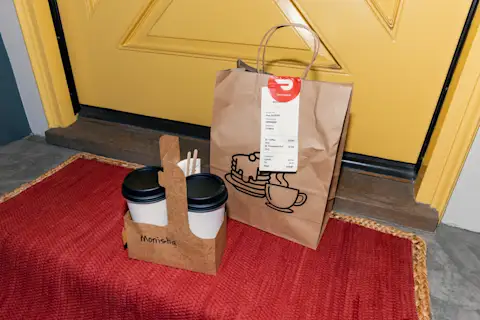
Use Marketplace for what it does best: discovery. Then bring those customers onto your own channels with a reason to come back. A card in the delivery bag, a first-order discount on your own website, or a follow-up email the next morning all give a first-time customer a nudge to order directly.
With ordering data linked to your loyalty program and email, you can spot a regular slipping away before they're gone for good. A customer who orders an oat-milk latte every Monday but has gone three weeks without a visit is a retention opportunity, and you can act on it automatically.
DoorDash Commerce Platform's Online Ordering and branded mobile app close that loop. A customer finds your café on Marketplace, and your branded ordering surface brings them back to order directly. Those direct orders build loyalty and repeat business, which strengthens your Marketplace presence in turn.
Online Ordering can increase sales by up to 8% of your current Marketplace sales (based on internal DoorDash data from January 2025 through May 2025).
Mobile apps see 150% more repeat customers than web ordering (based on internal DoorDash data from September 2024 to June 2025).
How Much Should a Coffee Shop Spend on Marketing?
This article is for educational purposes only and does not constitute financial advice. Consult a financial advisor or accountant before making budget decisions for your business.
The 3–6% rule. The common benchmark is 3 to 6% of gross revenue spent on marketing. A café doing $500,000 a year would put $15,000 to $30,000 toward marketing, or roughly $1,250 to $2,500 a month. Your highest-return tactics cost little or nothing: your Google Business Profile, reviews, email, and organic social. Paid ads should amplify what already works, not stand in for the fundamentals.
When paid ads make sense. Run them only after your organic channels are live and converting. If your website loads slowly, your reviews are thin, and you have no email list, ads will send traffic to a broken experience and waste the spend. Once the fundamentals are solid, test a small budget of $300 to $500 a month in Google Local Ads before you scale.
Mistakes That Cost Coffee Shops Time and Money
Counting followers instead of orders. Five thousand Instagram followers with no ordering link in your bio might look impressive, but what is it selling? Pick one or two revenue metrics, like weekly online orders or repeat customer rate, and track those instead.
Discounting until the margin disappears. Deep discounts train customers to wait for the next deal instead of paying full price. Instead of “buy one, get one” use small, targeted offers, like a tenth drink free or a birthday reward, so the incentive brings people back without giving away the margin you run on.
Marketing only when you remember. Willpower won't keep your marketing consistent, but systems will. Automate what you can, like email, review requests, and loyalty. Batch what you can't, like social posts. A simple content calendar keeps everything running when you’re busy
Start Turning Marketplace Customers Into Your Customers
You've already built momentum on DoorDash Marketplace. The next step is bringing those first-time orders back to channels you own, where daily repeat revenue grows without the commission.
DoorDash Commerce Platform extends your Marketplace presence with commission-free Online Ordering, Automated Email Marketing, Cross-Channel Loyalty, and a Branded Mobile App. One system, synced automatically, built on the same technology behind billions of DoorDash orders.
Online Ordering can increase sales by up to 8% of your current Marketplace sales.
Automated email marketing boosts order frequency by 15% on average.
Direct channels can drive up to $7,500 in sales in the first six months.
(Based on internal DoorDash data as of June 2025.)