You have a great food idea and customers ready to try it. In many places, though, you can’t legally sell food you make in your home kitchen. Building your own licensed kitchen also comes with large upfront costs before you sell a single dish.
Food entrepreneurs have plenty of customers waiting for food made off-site. According to the National Restaurant Association’s Off-Premises Restaurant Trends 2025 report, nearly 4 in 10 adults order delivery at least once a week. You don’t need a dining room to reach those customers. A licensed prep space can be enough to launch your food business.
This guide explains what a commissary kitchen is, what it costs, and whether you need one. You’ll also learn how to bring in orders once you start cooking.
This article is for educational purposes only and does not constitute legal or financial advice. Consult an attorney before signing any commissary rental agreement or lease.
Commissary kitchens at a glance
A commissary kitchen is a licensed kitchen that food businesses rent to make food they sell somewhere else.
The main types are shared kitchens, private kitchens, incubator kitchens, and central kitchens for multi-location restaurants.
Food truck operators, caterers, bakers, pop-up chefs, and delivery-only restaurants use them to cook legally without building their own kitchen.
Pricing usually follows one of three models: hourly booking, monthly membership, or a private lease.
Check your local health department’s rules before you sign a contract for any commissary kitchen.
What is a commissary kitchen?
A commissary kitchen is a licensed, commercial-grade kitchen that food businesses rent. They use it to prep, cook, and store food they sell somewhere else. Food trucks, caterers, and bakers use this commercial kitchen space to meet health and safety regulations without building their own.
A commissary kitchen serves two purposes. First, it’s a permitted facility where businesses make, store, portion, or package food that customers eat at another location. Second, it can act as a home base where food truck operators clean and restock their trucks.
You may see these spaces called shared-use kitchens, shared kitchens, or central kitchens. People often use these names interchangeably. The word “commissary” originally meant a store of supplies.
How does a commissary kitchen work?
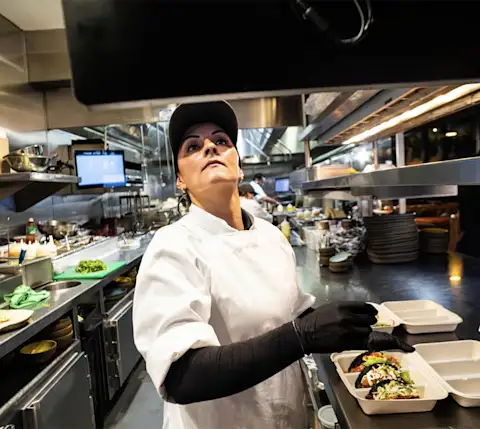
Commissary kitchens run on an owner-tenant model. The owner builds a kitchen that meets health code, holds the facility permits, and maintains the equipment. Tenants (the businesses that pay rent to use the space) book time slots, storage space, and prep stations. All foodservice operators in the building follow the owner’s house rules.
Picture a caterer with a 6 a.m. booking. She pulls ingredients from her assigned shelf in the walk-in cooler and preps on shared prep tables. Afterward, she cleans her station to the facility’s sanitation standard. She loads out before the next tenant arrives.
Here’s how responsibilities typically split between you and the kitchen:
What the kitchen usually provides | What you bring |
|---|---|
Commercial-grade equipment, such as ovens, mixers, and refrigerators | Smallwares (pots, pans, knives, and other small tools) |
Freezer space, dry storage, and cold storage | Ingredients and packaging |
A dish area for cleaning | Your own business permits |
Facility permits | Liability insurance |
Equipment lists vary, so ask for one before you book.
Commissaries aren’t your only option. Some restaurants, churches, and community centers rent out their licensed space during off-hours for extra income. A restaurant owner who doesn’t open until lunch, for example, can rent the space to a baker each morning. These options can cost less, but they often have fewer amenities and less predictable availability.
Types of commissary kitchens
The right type depends on how often you cook, how much control you want, and your budget. UF/IFAS Extension’s guide, An Introduction to Shared-Use Commercial Kitchens, explains that these facilities come in several models. You can rent space by the hour, day, or month. With that flexibility, food entrepreneurs can test new products with minimal upfront costs.
Shared commissary kitchens
In shared kitchen spaces, several businesses split the equipment and storage and book their own time slots. It’s usually the most affordable option. The trade-off is a tighter schedule and limited storage space.
Good fit for: food trucks, caterers, and early-stage bakers.
Private (dedicated) commissary kitchens
With a private kitchen, one tenant leases the entire space. You have full control and round-the-clock access, but you also pay the full rent yourself.
Good fit for: busy delivery-only brands and multi-truck operations that need access during peak hours.
Incubator kitchens
Incubators are shared spaces that add business support, such as mentoring, training, and sometimes help with licensing. Universities, nonprofits, and local economic development groups often run them. Some facilities call themselves accelerators. According to UF/IFAS, accelerators typically run short-term programs for fast-growing food businesses and may take a share of the company in return.
Good fit for: first-time founders who need guidance as much as space.
Central kitchens for multi-location restaurants
A restaurant group preps sauces, doughs, and proteins in one central spot and ships them to each location. Each restaurant then needs less prep space, and every location serves a consistent product.
Good fit for: restaurant owners with two or more locations.
Who uses commissary kitchens?
Here’s who rents commissary space and why.
Food trucks: Food truck operators prep food, store supplies, park overnight, and clean their trucks at a commissary. The next section covers whether your truck needs one.
Caterers: Caterers and catering companies book the space for high-volume prep before weddings, corporate events, and private parties.
Bakers and specialty food makers: They rent time on large commercial ovens and mixers that won’t fit at home.
Pop-up restaurants: Pop-up chefs test a concept with paying customers before they sign a long lease.
Delivery-only brands: Many delivery-only restaurants run entirely out of rented prep space, with no dining room. You may also hear these called ghost kitchens.
Existing restaurants: Some owners send overflow prep to a commissary when their restaurant kitchen runs short on space. Others launch a virtual restaurant brand without crowding the main line.
Do food trucks need a commissary kitchen?
In many states and counties, yes. The rules depend on where you operate, and your local health department has the final say. Rules can also differ between neighboring counties, so check with each county where you plan to sell.
Common requirements include:
Many health departments require food trucks to prep food, store supplies, and clean at a licensed commissary on a set schedule.
Some won’t issue a mobile vendor permit until you sign a commissary agreement (a contract confirming you’ll use a licensed facility).
Some areas make exceptions for fully self-contained trucks that can prep, clean, and store everything onboard.
You may also hear the term “servicing area.” A servicing area can be as simple as a spot to dump wastewater (the used water from your sinks) and refill fresh water. A commissary is an inspected food facility where you can also prep and store food.
Before you shop for a space, ask your county health department for its mobile vendor requirements. Securing a commissary agreement is one of the first permit steps when you’re figuring out how to start a food truck.
How much does a commissary kitchen cost?
Prices vary by city, facility size, and how often you book. Rates in big cities typically run well above those in smaller markets. Commissaries typically price their space in one of three ways:
Model | How it works | Good fit for |
|---|---|---|
Hourly booking | You pay only for the hours you book. | Part-time bakers, pop-ups, and new caterers |
Monthly membership | A flat monthly fee covers a set block of hours plus storage. | Food trucks and caterers with a steady schedule |
Private lease | You lease a dedicated space and pay monthly rent. | Busy delivery-only brands and large catering companies |
Base rent is only part of your budget. Plan for these extra costs too:
Security deposit: money you pay up front, which the facility holds while you rent.
Liability insurance: facilities may ask for a certificate of insurance (a document from your insurer that proves you have coverage).
Storage fees: extra charges for dry storage, cold storage, or freezer space.
Overnight parking: a fee to keep your food truck on-site.
Cleaning or utility surcharges: added fees some facilities charge on top of rent.
Your own permits: a business license and food handler permits.
Before renting a commercial kitchen, request itemized quotes from three local facilities. Ask each one to list exactly what the price includes.
Pros and cons of using a commissary kitchen
Renting has clear upsides and some trade-offs.
Pros | Cons |
|---|---|
Lower upfront costs than building your own kitchen | Rent becomes an ongoing monthly expense |
Commercial-grade equipment ready on day one | Scheduling conflicts with other tenants |
The owner keeps the facility up to code | Limited storage space |
Flexibility to book more or fewer hours as demand changes | Facilities often sit outside city centers, so drives run longer |
A low-cost way to test new products | Less control over the space |
If you compare monthly rent with the cost of opening a restaurant from scratch, a commissary is often the lower-risk way to start. Renting suits new or growing businesses that need licensed space without a big investment. If you cook long hours every day and want full control, a private lease or your own space may fit better.
Commissary kitchen vs. ghost kitchen vs. commercial kitchen
Here’s how the three compare:
Commercial kitchen | Commissary kitchen | Ghost kitchen | |
|---|---|---|---|
What it is | Any space built to health code for selling food | A commercial kitchen you rent from an owner | A delivery-only business model with no dining room |
Who uses it | Restaurants, caterers, and other foodservice operators | Food trucks, caterers, bakers, and pop-ups | Delivery-only and virtual restaurant brands |
Is there a storefront? | Sometimes, such as a restaurant kitchen with a dining room | No | No |
How customers order | In person, by phone, or online, depending on the business | From the business at another location, like a food truck window or catered event | Online, through delivery services or the brand’s own site |
Typical setup | Owned or leased by one business | Shared stations or private rooms rented to tenants | Often runs out of a commissary or other rented space |
“Commercial kitchen” is the umbrella term for any space built to health code for selling food. A commissary is one type of commercial kitchen, and you rent it. A ghost kitchen describes a business model: a delivery-only brand with no dining room that often runs out of a commissary.
How to choose and rent a commissary kitchen
Follow these five steps in order:
List what you need. Write down the equipment, storage, and hours your food business requires.
Check your health department’s rules first. Confirm local requirements before you tour anything, just as food truck operators do.
Find spaces near you. Search online directories, ask your county health department, or contact local incubators.
Tour and vet each option. Ask about its inspection history, and check cleanliness, storage space, and parking. Confirm whether drivers and customers can reach the kitchen door to pick up orders.
Read the contract closely. Look for minimum hours, notice periods, rate increases, and insurance requirements. Have a lawyer review it before you sign.
No storefront? How to get orders from a commissary kitchen
Customers can’t walk into a commissary to order, so they need another way to find you. According to the 2026 DoorDash Restaurant Industry Trends Report, 37% of consumers discover new restaurants on delivery apps. In 2025, over 55% of orders at new restaurants on DoorDash were from consumers who were browsing, not looking for a specific restaurant (based on internal DoorDash data from Jan 2025 – December 2025).
You can list your business in the DoorDash app, where nearby customers already browse for food. This service is called DoorDash Marketplace. When someone orders, a Dasher picks up the food at your commissary and delivers it.
A few setup steps can make Dasher pickups and deliveries smoother:
Clear Dasher instructions: Commissaries often house several businesses at one address, so Dashers may need extra direction. You can add Dasher pickup instructions in the Merchant Portal, such as where to park, which door to use, and where orders wait.
Packaging that travels well: Use sealed, insulated containers that hold food at the right temperature.
A photo-rich menu: Merchants with at least 25 menu item photos see close to 2X more sales than merchants with fewer or no photos in their first four weeks on DoorDash (based on internal DoorDash data from merchants activated between Jan 2025 and May 2025).
Start getting orders from your commissary kitchen
Renting a commissary gives you a place to cook. The next step is helping customers find you. Marketplace connects businesses without a storefront to nearby customers, with delivery by Dashers, through DoorDash. Your team takes on minimal extra work.
New to DoorDash? List your commissary-based business on Marketplace, and you can start reaching customers right away. More than 20% of stores get their first order within 24 hours of activation (based on internal DoorDash data from May 2025 through December 2025).
Already on Marketplace? If you’re using a commissary to launch a delivery-only brand or reach a new service area, set it up as its own store. New customers can then discover it on its own.
Get Started with DoorDash Marketplace