Comparing food delivery apps for your restaurant is harder than it should be. Many "best delivery service" lists look like fair comparisons but push you toward whatever product the writer is selling.
This guide is different. We'll look at the food delivery services restaurants are choosing between in 2026 and compare them on what affects your bottom line: commission fees, reach, and how each platform handles your customer data. No spin, no single winner. Just a clear look at your options.
Quick Answer: How the Top Delivery Services Compare (TL;DR)
Platforms differ most on three points: what you pay in fees, how many new customers each one brings, and whether you keep access to your customer data.
DoorDash offers flexible plans that scale from delivery-only to added visibility and marketing support.
Uber Eats and Grubhub each offer tiered pricing and subscriber perks that affect order volume.
Many restaurants run two or more platforms at once, widening their reach and reducing reliance on any single app.
Commission fees are just one piece; your point-of-sale (POS) system and local market shape the right fit as much as price.
The full side-by-side comparison, plus a commission table, is below.
How to Choose the Right Delivery Service for Your Restaurant
Before you compare specific apps, it helps to know what you're comparing them on. Weigh each delivery service against the factors below before you sign up.
Availability in Your Market
Not every delivery app operates in every city. A platform that dominates headlines nationally might have thin coverage where your restaurant sits. What counts is how many active customers are already ordering in your zip code, not the app's total size or how many other restaurants have signed up. A market with fewer restaurants on a platform can still have strong, ready customer demand, and sometimes that means less competition for those orders. Check which services show active customer demand in your area, not just current restaurant supply.
Commission and Fee Structure
Commission is the percentage of each order the platform keeps. Most apps offer tiered plans: a lower commission gives you less visibility, while a higher one can bring more reach and added marketing support. The right tier depends on how much new business the platform brings versus what you pay to reach those customers.
POS and Operations Fit
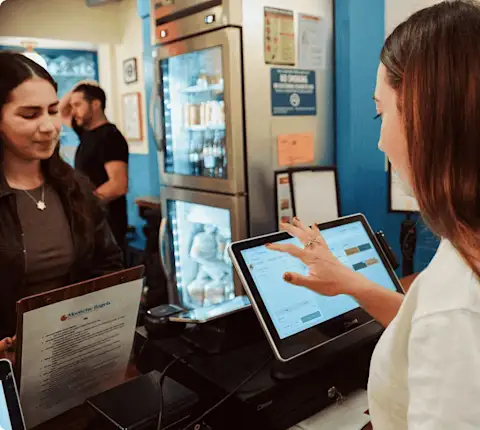
How well a delivery app works also depends on how it connects to your kitchen. If orders land on a separate tablet, your staff juggles one more screen during a rush. The better setup routes delivery orders straight into your existing point-of-sale (POS) system, so tickets print alongside your dine-in orders. DoorDash connects with more than 30 POS providers, which keeps most restaurants on the systems they already run.
Comparing the Top Delivery Services for Restaurants in 2026
Here's how the top three platforms compare on price, reach, and daily operations. Figures below are current as of 2026; check each provider's pricing page for the latest rates.
DoorDash
DoorDash is a common starting point for restaurants adding delivery, in part because of how customers use it to find new places to eat. In 2025, over 55% of orders at new restaurants on DoorDash were from consumers who were browsing, not necessarily looking for a specific restaurant (based on internal DoorDash data from Jan 2025 - December 2025).
What restaurants pay: DoorDash uses three commission tiers:
Basic: 15%, delivery only.
Plus: 25%, adds a wider delivery radius and DashPass, which can help more customers find and order from you.
Premier: 30%, adds increased visibility and additional marketing support, such as a photoshoot credit and automatic ads.
Pickup orders carry a 6% commission on all three plans (DoorDash Merchant Pricing). On top of commission, you'll pay standard payment processing and any optional marketing spend, such as Sponsored Listings and Promotions. Payouts arrive weekly by default.
What customers pay: Customers cover a delivery fee ($2–$8, waived for DashPass members on eligible orders), a service fee (usually 10–15% of the subtotal), a small order fee ($2 on orders under $10–$12), and a tip (suggested 15–20%, which goes to the Dasher).
Restaurants on the Plus and Premier plans are part of DashPass, so members ($9.99/month or $96/year) pay $0 delivery fees on their orders over $12. That perk can bring more repeat visits, and loyalty tends to lift order frequency: 66% of consumers order more often from restaurants where they use a loyalty program (2026 DoorDash Restaurant Industry Trends Report).
Orders route into your existing POS system, and customers follow their food with real-time tracking from kitchen to door.
Uber Eats
Uber Eats runs a large delivery network across the US and reaches a wide customer base, which gives restaurants strong exposure across major metro areas.
What restaurants pay: Uber Eats uses three tiers:
Lite: 20% marketplace fee nationally.
Plus: 25% marketplace fee, plus 5% more to include Uber One member orders.
Premium: 30% marketplace fee, with Uber One included at no added cost.
Pickup runs 7% with validated in-store pricing, or 10% without. Premium also comes with ad-spend matching up to $100/month and six months of low-volume protection: for the first six months, Uber Eats reimburses Marketplace Fees in any month with fewer than 20 orders, as long as the store stays online for at least 95% of its listed hours and keeps cancellations and missed orders low (Uber Eats Merchant Pricing).
What customers pay: Delivery fees, service fees, small order fees, and tips vary by distance and market. Uber One members ($9.99/month) pay $0 delivery fees on eligible orders that meet the minimum shown on each store's page (Uber One). Members also see discounted orders and tend to order more often and spend more per order than non-members. (Uber Eats Merchant Pricing).
Grubhub
Grubhub holds a solid presence in many markets, where it draws a loyal customer base. Its pricing centers on what it calls a "marketing commission."
What restaurants pay: Grubhub uses three tiers:
Basic: 5% marketing commission only, delivery excluded. Restaurants using Grubhub's own driver network pay an additional 10% delivery fee on top of the 5% (per Grubhub's pricing guide).
Plus: 15%, adds a free menu photoshoot and Grubhub+ access.
All-access: 20%, adds sponsored listing placements.
You'll also pay payment processing, and payouts arrive weekly. Pickup orders carry only your plan's marketing commission, since no delivery fee applies (Grubhub Pricing and Fees).
What customers pay: Delivery fees, service fees, and small order fees run similar to other platforms. Grubhub+ members ($9.99/month) pay $0 delivery fees on orders over $12 (Grubhub Pricing and Fees).
Higher commission tiers lower the delivery fee customers see, which can lift order volume but costs you more per order. Whether that trade-off pays off depends on your market and how strong Grubhub's local presence is where you operate.
Postmates
Uber completed its acquisition of Postmates in 2020 (Nation's Restaurant News), and restaurants now sign up for Postmates through Uber Eats. If you're weighing it, you can expect delivery economics similar to Uber Eats' tiers rather than a separate rate card.
Customer fees, service fees, and tips follow the same Uber Eats framework, with no distinct Postmates pricing.
One note: some customers still see the Postmates app and brand, but the commission terms restaurants pay run through Uber Eats.
Here's how the three platforms line up side by side:
DoorDash | Uber Eats | Grubhub | |
|---|---|---|---|
Market reach | US coverage | Large US network, strong in metro areas | Strong in urban markets |
Commission approach | 15–30% (tiered by plan) | 20–30% (tiered by plan) | 5–20% (marketing commission; delivery adds a separate fee) |
Delivery network | Dashers | Uber couriers (also powers Postmates) | Grubhub drivers or restaurant's own |
Data sharing with restaurants | Limited guest data on Marketplace orders | Limited guest data shared on delivery orders | Limited guest data shared on delivery orders |
Quick Reference: Commission Tiers at a Glance
Commission is one factor among several, alongside reach, POS integration, and how much your local customers lean on a platform's subscription perks. Use this table to compare tiers at a glance.
Platform | Entry Tier (Delivery) | Mid Tier (Delivery) | Top Tier (Delivery) | Pickup |
|---|---|---|---|---|
DoorDash | Basic — 15% | Plus — 25% | Premier — 30% | 6% (all plans) |
Uber Eats | Lite — 20% | Plus — 25% (+5% for Uber One orders) | Premium — 30% (Uber One included) | 7% validated / 10% unvalidated |
Grubhub | Basic — 5%* | Plus — 15% | All-access — 20% | Plan's marketing commission only |
*Grubhub's Basic tier is a marketing-commission-only rate. Restaurants using Grubhub's own driver network pay an additional 10% delivery fee on top of the 5%.
Common Delivery Platform Fees and Terms, Explained
New to delivery apps? These are the terms to know before you sign up.
Commission: The percentage of each order the platform keeps in exchange for listing your restaurant and, on some plans, handling delivery.
Service fee: A charge the customer pays on top of the food total, usually a percentage of the subtotal. It goes to the platform, not your restaurant.
Delivery radius (or zone): The geographic area a platform will deliver your food to. Orders outside that zone either cost more or won’t go through. On DoorDash, higher plan tiers typically come with a wider delivery radius.
Exclusivity agreement: A deal where you list on one platform only, often in exchange for a lower commission rate. It limits your reach to that platform's customers.

Should You Use One Delivery App or Several?
There's no single right answer here. Whether or not you use one delivery app or multiple comes down to the trade-off between cost and reach.
Committing to one platform can qualify you for a lower commission tier, sometimes through an exclusivity agreement. You pay less per order, but you only reach that platform's customers. If it's weak in your market, you're leaving orders on the table.
Listing on several platforms widens your reach and lowers your dependence on any single app's policies or pricing changes. The downside is added work. Each platform can bring its own tablet, its own menu to keep updated, and its own login for your staff to track during a rush.
Some restaurants also run their own in-house delivery with their own drivers. You gain full control over the customer experience and your guest data, but you take on the staffing, routing, and insurance. A common mix: delivery platforms for reach, in-house delivery for loyal regulars nearby.
The stakes rise if you run a delivery-only restaurant with no dine-in traffic. With every order coming through these platforms, listing on several can protect your revenue stream from one app's slow market or policy shift.
That operational load eases when orders route into one POS system instead of separate tablets. A setup that consolidates delivery orders into your existing point-of-sale keeps multi-platform listing from turning into a daily headache.
Grow Your Reach with DoorDash Marketplace
Choosing a delivery platform shouldn't feel like a guessing game. DoorDash Marketplace gives you room to fit your restaurant's size and budget, with flexible plan tiers, broad customer reach, and integrations that connect to more than 30 POS providers.
If you're not on Marketplace yet, it's a low-lift way to start reaching new customers in your area. And if you're already on it, now's a good moment to revisit your plan tier as your needs change.
Ready to reach more customers?
Get Started with DoorDash Marketplace