You've probably thought about starting a coffee shop loyalty program. Maybe you already have a stack of paper punch cards sitting by the register. The problem is that those cards get lost in pockets, forgotten in bags, or never filled. And there's no way to know if they're actually bringing anyone back.
This guide walks you through choosing the right rewards program structure, launching it in a few simple steps, and making sure it works everywhere your customers order, not just at the counter.
TL;DR
A coffee shop loyalty program turns a daily habit into a reason to pick your shop over the chain down the block.
Stamp-based structures ("buy 9, get the 10th free") work best for most coffee shops because they're easy for staff and customers.
You don't need to build an app. A digital loyalty card in Apple Wallet or Google Wallet does the job without the cost.
Your loyalty program should count every order, whether a customer walks in, orders delivery, or orders from your website.
Track repeat visits, referrals, and average spend to know if your program is working.
The most important step: pick a simple structure and launch it this week instead of waiting for the perfect setup.
Why coffee shops need a loyalty program
Drinking coffee is a habit. Most of your regulars visit every day, sometimes twice. The goal of a customer loyalty program isn't to create new habits. It's to make sure that the habit points to your shop and not the one across the street.
Picture a single-location independent coffee shop. Call it Maple Street Coffee. The owner sees the same faces every morning. She knows their orders by heart. But there's nothing in place to actually reward those visits, and nothing to encourage a customer to come in on a day they might skip. Meanwhile, the chain down the block runs Starbucks Rewards, complete with push notifications, personalized rewards, and free items after every few purchases.
That gap matters more than it might seem. Sixty-one percent of restaurant customers said a loyalty program is an important factor when choosing a restaurant for a delivery order, and 54% of limited-service customers said they prefer places where they are loyalty members (Nation's Restaurant News). Even more telling, 76% of limited-service restaurants saw a traffic increase in 2024 that they attributed to their loyalty program (Nation's Restaurant News).
You don't need a massive tech budget to compete. You need a simple structure, a clear reward, and a way to stay top of mind. Customer retention starts with giving regulars a reason to keep choosing you.
Choose your loyalty structure: stamps, points, or tiers
There are dozens of loyalty structures out there, but only two or three actually fit a coffee shop's low average ticket and high visit frequency. Here's what makes sense.
Stamp-based ("buy 9, get the 10th free"): This is the default for most coffee shops, and for good reason. Customers understand it instantly. Staff doesn't need to explain it. There's no math at checkout during a morning rush. A digital stamp card replaces the old paper stamp cards that customers lose, and it tracks progress automatically. If most of your sales are drinks in a narrow price range, stamps are your best bet.
Points-based system: If your menu spans a wider range, including espresso drinks, food items, merchandise, and bags of specialty coffee, a points-based system gives customers credit based on what they spend. Loyalty points add up across different price levels, so a customer buying a $6 latte and a $4 pastry earns more than someone ordering a $3 drip coffee. This works well if you want to encourage customers to explore beyond their usual order. Some shops add light gamification to this structure, like bonus points for trying a seasonal drink.
Tiered programs: Tiers reward your most loyal customers with better perks as they visit more. This can work eventually, but it's not where most coffee shops should start. It adds complexity, and you want your program running before you start layering on extras. Think of tiers as something to add six months in, once you know what your regulars respond to.
Maple Street Coffee's owner picks a stamp-based structure. The menu is mostly drinks in a tight price range, and the morning rush doesn't leave time for explanations. Nine stamps, one free drink. Simple.
How to launch your loyalty program step by step
You don't need weeks of planning. Here's a simple launch sequence you can act on today.
1. Set the reward and the path to earn it. Decide what the customer gets and how many visits (or how many loyalty points) it takes. For a stamp-based coffee shop loyalty card, "buy 9, get the 10th free" is the standard because it feels fast enough to stay motivated. Make sure the reward is something customers actually want, like a free drink, not a discount on merchandise.
2. Pick your format. Decide where the program lives. A digital loyalty card that sits in a customer's phone wallet means no physical cards to print, lose, or forget. Most digital loyalty programs let you generate a QR code that customers scan at the counter. If your point-of-sale system supports POS integration, you can tie the program directly to checkout so stamps or points get added automatically.
3. Add your branding. Your loyalty card or app screen should look like it belongs to your shop. Add your logo, your colors, and a short welcome message. This takes minutes with most digital loyalty cards platforms, and it makes the program feel intentional, not like a generic third-party add-on.
4. Promote it at the counter. Train your staff to mention the program in one sentence at checkout: "Want to start earning a free coffee?" Print a QR code sign for the register and the door. Post about it on your social media with a clear sign-up link. The launch doesn't need to be a big event, just a consistent mention.
5. Start tracking from day one. Even a basic setup gives you customer data you never had with paper punch cards. You'll see how many customers enroll, how fast they earn rewards, and how often they come back. That information shapes everything you do next.
Maple Street's owner sets the reward, adds the shop logo to a digital stamp card, prints a QR code for the counter, and tells staff to mention it at checkout. The whole setup takes an afternoon.
Should your loyalty program live in an app, a card, or something else?
An independent coffee shop doesn't need to build a standalone app from scratch to keep up with loyalty apps run by national chains. That costs thousands of dollars and months of development — and many customers won't download yet another app for one coffee shop.
A digital loyalty card in Apple Wallet or Google Wallet solves this. Customers tap to add it once, then scan a QR code or pull up the card at checkout. No app download, no account, no login to forget.
For Maple Street Coffee's owner, that's the right call — no budget or time for a custom app, and a wallet-based stamp card gets the job done.
If you're already on DoorDash Marketplace, Cross-Channel Loyalty is worth knowing about too. It lets customers earn and redeem rewards whether they order in-store, through delivery, or on your own branded website or app — the only program that works across all four in one place, so you're not running separate systems or missing credit for orders placed outside your walls.
And if your coffee shop has strong repeat traffic, a branded mobile app — built and maintained by DoorDash, not from scratch, as part of DoorDash Direct's Pro package — is worth considering. Customers on a branded mobile app are 30% more likely to reorder compared to web ordering channels (based on internal DoorDash data from January 2025 to June 2025).
Make loyalty pay off everywhere customers order
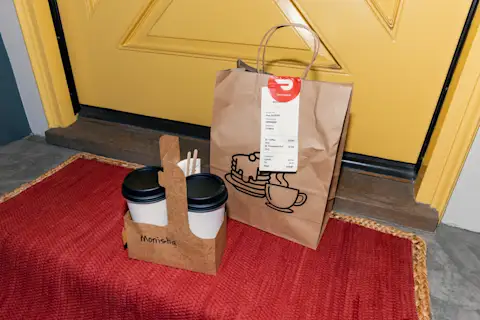
Here's where most coffee shop rewards programs break down. A customer walks in every morning and earns stamps. Then one afternoon, they order delivery from their couch. That order doesn't count toward their reward. The next week, they place a pickup order through your website. That doesn't count either.
The same regular who visits five days a week might only get credit for three of those visits because the other two happened outside the store. That's a customer retention problem hiding in plain sight.
Why this gap is bigger than it looks
Maple Street Coffee runs into this exact issue. The owner adds delivery and online pickup, and the business picks up. But the in-store loyalty program doesn't cover those orders. Regulars order delivery but never earn a stamp. They start to feel like the rewards program doesn't apply to them.
Most shop owners underestimate how common this is:
90% of consumers said they would use a loyalty program that spans reservations and delivery
87% said a credit, discount, or perk influenced them to reorder
66% said they engage more often with restaurants where they're loyalty members
(2026 DoorDash Restaurant Industry Trends Report)
Closing the gap with online ordering
A branded website or app powered by Direct Ordering — DoorDash Direct's commission-free ordering tool (a standard 2.9% + $0.30 payment processing fee applies) — can carry the same loyalty program you run in-store. Customers earn rewards no matter where the order comes from, and you keep the connection across every channel. Direct Ordering can increase sales by up to 8% of current Marketplace sales (based on internal DoorDash data from Jan 2025 through May 2025).
When loyalty follows the customer instead of resetting at the counter, visit frequency goes up because every order feels like progress toward a reward.
How to tell if your loyalty program is working
You don't need a dashboard full of metrics to know if your coffee loyalty program is doing its job. Here are four signals a solo owner can realistically check.
Repeat visits are climbing. Are the same customers coming in more often than before you launched? If you're using a digital loyalty program, your provider's basic reporting will show this. You're looking for an increase in visit frequency among enrolled customers. Even a small bump matters for a daily-habit business like coffee.
Customers are finishing their cards. If people sign up but never reach the reward, the gap between visits and payoff is probably too wide. A healthy redemption rate means your reward feels reachable.
You're hearing about it. Referrals, word-of-mouth mentions, and online reviews that name the rewards program are strong signs. If a customer posts about your loyalty program or tells a friend, that's free marketing you didn't pay for.
Average spend is going up. Enrolled customers sometimes spend more per visit because they're motivated to reach their reward faster, adding a pastry to their usual coffee or upgrading to a larger size. Cashback-style programs or points-based systems tend to drive this more than simple stamps.
Maple Street's owner checks these signals a few months in. More regulars are finishing their stamp cards, a handful of new customers mention the rewards program when they first visit, and weekday traffic has picked up slightly.
Simple ways to get more regulars enrolled
The best coffee shop loyalty program in the world doesn't help if nobody signs up. Here's how to get more of your regulars enrolled without turning your staff into salespeople.
Make sign-up a single tap. If enrollment requires downloading an app, creating an account, or typing in an email address at the counter, you'll lose people. A QR code at the register that adds a digital loyalty card to Apple Wallet or Google Wallet in one tap removes every barrier. No app download, no form to fill out.
Have staff mention it once per transaction. Not a pitch, just one sentence: "Have you joined our coffee shop loyalty card? Buy nine, your tenth is free." Train this as part of the checkout flow so it happens naturally, not as an awkward add-on. Consistency matters more than enthusiasm.
Run an occasional double points day. Pick your slowest day and offer double stamps or double points for that day only. This drives traffic exactly when you need it most and gives customers a reason to break their usual routine. Maple Street's owner runs a slow-Tuesday double-stamp promotion and sees more regulars stopping by earlier in the week.
Replace paper with digital. If you're still using paper punch cards alongside a digital program, phase out the paper. Paper stamp cards can't send reminders, can't track customer data, and can't tell you anything about who's coming back. A digital loyalty card that lives on a customer's phone can't be lost, forgotten, or left in the car. The switch alone can lift enrollment and completion rates.
Mistakes that kill a coffee shop loyalty program
Even a well-designed rewards program can fail if you fall into a few common traps.
Making the reward too hard to reach. If a customer needs 20 stamps to earn a free coffee, most will stop trying after stamp five. The reward should feel reachable within a regular customer's normal visit pattern. For most coffee shops, somewhere between 8 and 12 visits is the sweet spot.
Setting it and forgetting it. Launching a loyalty program and never mentioning it again is the fastest way to kill enrollment. Promote it every week with a sign at the register, a social media post, and a mention at checkout. Your loyalty strategy should include ongoing visibility, not just a launch day push.
Treating every customer the same. A first-time visitor and a five-day-a-week regular shouldn't get the same generic offers. Personalized rewards make customers feel recognized. Even something simple like a birthday freebie or an extra stamp for trying a new menu item goes a long way. But most shop owners aren't doing this yet. Only 30% of operators target all of their promotions to specific customer groups or behaviors, and just 27% very confidently know which of their campaigns actually led to repeat visits (DoorDash Restaurant Reservations and Operations Trends Report 2026).
Ignoring off-premise orders. A loyalty program that only counts in-store purchases misses every delivery, pickup, and online order. If a regular orders delivery twice a week and never gets credit, the program is working against you. Extending rewards across every ordering channel, including your POS systems and online ordering, is what turns a counter-only program into a real customer retention tool.
Build loyalty that follows your customers everywhere
You already know your regulars by name and order. A coffee shop loyalty program makes sure they get credit for every visit, whether they walk in, order pickup, or order through delivery.
Cross-Channel Loyalty connects to Direct Ordering and a branded website powered by DoorDash Direct, so rewards follow the customer instead of resetting at the counter. One program, every channel, no extra tools to manage.
Direct Ordering can increase sales by up to 8% of current Marketplace sales (based on internal DoorDash data from Jan 2025 through May 2025).
Get Started with DoorDash Direct