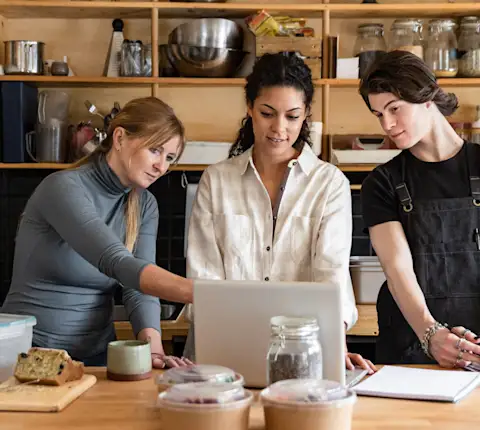
Running a busy dining room takes constant effort. Your food leaves the kitchen hot, servers greet regulars warmly, and guests leave satisfied. That's the hard part, and you've already done it.
But the guest experience doesn’t stop at the front door. It also includes your online ordering experience, how you reconnect with guests after a meal, and how you respond to reviews.
This playbook explains what restaurant customer experience looks like today, why it affects your bottom line, and 7 strategies to improve every stage of the guest journey.
TL;DR
Restaurant customer experience includes every in-person and online touchpoint, from a guest's first search to post-meal follow-up.
Research links higher online ratings to more revenue for independent restaurants.
The guest journey has four stages: Discover, Choose, Experience, and Return.
Many guests switch between dine-in and delivery, so every channel needs the same level of care.
Small restaurants can start with low-cost habits like pre-shift huddles and recipe checklists.
What is restaurant customer experience?
Restaurant customer experience includes every touchpoint a guest has with your restaurant. A touchpoint is any moment a guest interacts with you, in person or online. It starts when someone searches for a place to eat. It continues through the meal, the follow-up, and their decision to come back.
In the dining room, the experience includes food quality, speed of service, cleanliness, and ambience. Online, it includes how guests find you, order from you, and hear from you after a visit.
What's the difference between customer service and customer experience?
Customer service is a single interaction. A server answers a menu question, a host takes a phone call, or a staff member hands over a takeout bag.
Customer experience is the sum of every interaction across the guest journey: discovery, ordering, the meal, and what comes after. Good service is a friendly server who takes an order correctly. A good experience is that same guest getting a follow-up that mentions their usual order before the next visit.
What guests value most
Deloitte's research on restaurant guests found that what diners value is consistent across age, income, region, and gender.
That's good news for a small restaurant with no research budget. You don't need to sort guests into groups by age or income. Instead, focus on the five elements Deloitte identified:
Engage: Treat each guest warmly, as a person.
Empower: Let guests customize orders, and respond to their feedback.
Hear: Listen to each guest's needs and acknowledge them.
Delight: Create memorable moments with personal touches.
Know: Remember guests and their preferences.
The same five apply online — in how guests order, whether you follow up after a visit, and how you respond to customer feedback.
Why customer experience drives restaurant profitability
Customer satisfaction shows up in your online ratings, and ratings affect revenue. A one-star increase in a Yelp rating leads to a 5–9% revenue increase for independent restaurants. (Luca, Harvard Business School working paper, 2011).
The link between experience and revenue follows a simple cycle:
Great experience → better reviews and referrals → more first-time guests → more repeat business
A poor experience costs more than one check. Picture a party of four walking out at 7 p.m. on a Friday after long wait times for a table. You lose their food and drink order, and you may not fill that table again during the rush. You also lose their future repeat visits and any friends they might have referred.
To estimate that loss for your restaurant, multiply your average check per person by four. Then consider how often those diners might have returned over a year.
The modern guest journey: how customers discover, choose, experience, and return
Every guest moves through four stages, each tied to a question they want answered:
Discover: Where should we eat?
Choose: Can I order it my way?
Experience: Am I glad I came?
Return: Will I come back?
Only one of these stages takes place in the dining room. Discover, Choose, and Return often depend on search results, online menus, and follow-up emails.
The stages also feed one another. A review a guest leaves after a meal helps the next person searching for a place to eat. A returning guest skips Discover entirely and starts at Choose.
Keep in mind that guests also move freely between channels. 74% of dine-in consumers later order delivery from the same restaurant (based on the DoorDash Restaurant Reservations and Operations Trends Report 2026). Your experience needs to hold up across dine-in, delivery, and online ordering alike.

7 strategies to improve restaurant customer experience
These 7 strategies aren't ranked. They're grouped by where they happen in the guest journey:
Strategies 1 through 3 cover Experience, in the dining room.
Strategy 4 covers Choose.
Strategy 5 covers Return.
Strategy 6 connects Return back to Discover.
Strategy 7 covers the restaurant technology that ties all four stages together.
1. Train staff to personalize every interaction
Friendly service in the moment is important, but personalization is what helps guests feel known when they come back. That starts with remembering the details that matter — a regular’s usual order, a dietary need, or even just their name.
Great service also looks different depending on the occasion. A business lunch may need to feel quick and seamless. An anniversary dinner may call for a more relaxed pace.
Simple habits can make that easier. Use a short pre-shift huddle to review the day’s reservations and expected regulars. Keep shared notes where staff can easily reference guest preferences across shifts, whether that’s in your POS, a customer relationship management tool (CRM), a notebook, or a whiteboard.
2. Keep food quality and consistency non-negotiable
Regulars expect their favorite dish to taste the same on the fifth visit as it did on the first. Consistent food quality depends on written-down systems, not one cook's memory.
Three low-cost steps help:
Recipe cards with exact measurements and portion sizes
Plating photos posted at each station
A quality check at the pass before dishes leave the kitchen, especially during rush periods
The final check also protects order accuracy by catching a missing side or wrong modification before a plate reaches the table. Prep checklists protect you from staff turnover, too. When a cook leaves, undocumented recipes leave with them.
3. Create an ambience that matches your brand
Ambience should reflect your concept and the guests you serve. Quick-service restaurants (QSRs), such as fast food or fast-casual spots, call for bright lighting and upbeat music. A date-night bistro calls for warmer light and lower volume.
Review these elements regularly:
Lighting: Brightness and color temperature
Music: Genre and volume, loud enough for energy but quiet enough for conversation
Layout: Table spacing and cleanliness
Details: Decor, scent, and table settings
Walk through the dining room during a busy shift and check each one. Loud music at a quiet dinner spot or cluttered side stations can undercut an otherwise strong meal.
4. Make ordering effortless, wherever guests order from
A clunky ordering process can undo great in-person service. Once a month, place a test order on your own website using your phone, just like a guest would. Note any step that slows you down, from finding the menu to paying.
Then check that your site covers these basics:
A clear “Order Now” button: Place it at the top of every page so guests never have to hunt for it.
Guest checkout: Let people order without creating an account first.
A complete menu: Show every item, price, and modification before guests reach checkout.
A special requests field: Give guests a place to note allergies or substitutions that reaches the kitchen.
Easy reordering: Let returning guests repeat a past order in a tap or two.
You can make these changes yourself with a website builder, or hire an agency to handle them. If you’d prefer a hands-off approach, consider a Branded Website from DoorDash Direct. DoorDash Direct is a set of online ordering and marketing tools that works alongside your DoorDash Marketplace listing. Your site is built from the menu and photos already on Marketplace and follows ordering best practices from day one. With Direct Ordering, guests can order straight from it, commission-free.
5. Remember guest preferences automatically
65% of consumers say a restaurant remembering their preferences would affect how often they choose it (based on the DoorDash Restaurant Reservations and Operations Trends Report 2026). That means remembering guests' preferences can have a real impact on your bottom line.
Loyalty programs are a great way to show guests that you remember them and give them another reason to return. And guests want loyalty programs to work across the channels they prefer to use, whether that's your website, branded app, in-store, or on DoorDash.
Cross-Channel Loyalty from Direct does just that, letting guests earn and redeem rewards from your loyalty program on DoorDash, on your website, and in-store. You can reward regulars and surprise them with perks. Guests can use their points wherever they order, which makes the program easier to use and shows you value your guests no matter what channel they prefer to order from you.
6. Ask for feedback and close the loop
Responding to reviews takes time, especially when they’re spread across Google, Yelp, DoorDash, and other sites. If you want to save time, consider a reputation management tool (software that pulls reviews from different sites into one place).
Guest Experience Management, available with Direct, does just that. It brings all your reviews and feedback into one dashboard. It automatically texts guests after their meal, inviting them to share a review. It also drafts AI-assisted replies you can review before posting. And because it’s built into your Merchant Portal, there’s one less login to remember!
7. Connect your tools so nothing falls through the cracks
Guests feel it when your systems don’t talk to each other. A regular who orders online gets treated like a stranger at the counter. An allergy saved in one system never reaches the kitchen on another channel. And 1 in 5 operators still can’t identify the same guest across dine-in, takeout, and delivery (based on the DoorDash Restaurant Reservations and Operations Trends Report 2026).
Disconnected systems also slow your team down. Staff re-enter menu changes in several places instead of focusing on guests. 40% of operators use four to five separate systems to run core operations. (DoorDash Restaurant Reservations and Operations Trends Report 2026).
When selecting restaurant tech, look for systems that offer multiple tools in one place and offer a broad set of integrations, so you can connect to other platforms. Direct connects ordering, loyalty, email, and reviews in one system. Menu updates sync everywhere, and each guest’s history lives in one profile, whether they order on DoorDash or on your own website. Plus, with a broad set of POS integrations, Direct orders show up on your POS system as usual. That way, your team can recognize a regular and their usual order, no matter how they reach you.
How to measure restaurant customer experience
Improving the guest experience only pays off if you can see it working. Tracking a few numbers each month shows where guests feel cared for and where they drift away. It also shows whether your efforts are building stronger customer retention over time.
Many of these numbers come from online orders and reviews, where guests never meet your team. To learn how restaurants make those moments feel just as personal, watch our webinar on bringing your hospitality beyond the dining room.

Common restaurant customer experience mistakes to avoid
Each mistake below starts as an everyday habit and can reduce guest complaints.
Treating review replies as optional. Guests who leave a review and hear nothing assume their feedback went nowhere. Unanswered complaints also stay public for the next person deciding where to eat.
Being warm in person but slow online. Delivery guests never meet your dining room team. They only see wait times, order updates, and how quickly you answer messages. That experience can decide whether they ever visit: 62% of consumers say ordering delivery led them to later dine in at the same restaurant (based on the DoorDash Restaurant Reservations and Operations Trends Report 2026). If your website or mobile app is slow or confusing, you may never get that first visit.
Letting quality vary by location or channel. When a dish tastes different at pickup than at dine-in, guests say your restaurant "isn't the same." Standard recipes and prep checklists keep quality steady across shifts and channels.
Training only for politeness instead of personalization. Friendly staff who never remember a regular's name or order leave repeat customers feeling like strangers. Recognizing regulars builds customer loyalty. Tools that store preferences also improve the employee experience — your team's day on the job — since staff no longer rely on memory alone.
Bring your hospitality beyond the dining room
A great restaurant customer experience extends to every interaction guests have with your business. From browsing your website to placing an online order or opening a follow-up email, each touchpoint is a chance to show the same care you bring to your dining room—and give guests a reason to return.
Ready to put that into practice? Watch our on-demand webinar, Beyond the Dining Room: Bringing Hospitality Online, with hospitality expert Preston Lee of The Thirty Percent Rule. You’ll learn how to make your digital experience easier, more personal, and true to your restaurant, without adding another full-time job to your plate. Sign up to get access to Preston’s Follow-Up Protocol, including email templates, so you can bring your hospitality straight to customers’ inboxes.
Launch Direct Ordering Today!