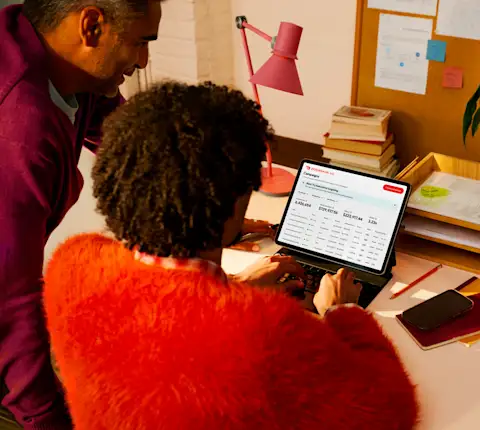
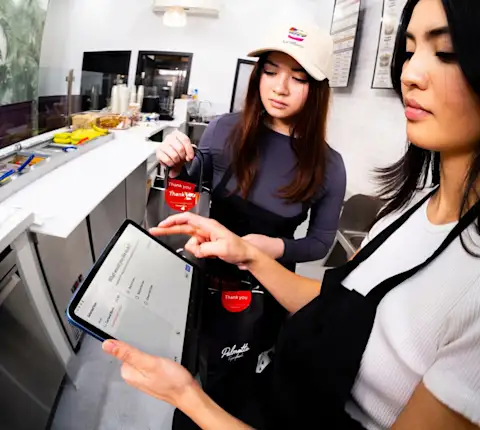
The restaurants seeing real growth aren't just listing themselves on delivery apps and hoping for the best. They're using DoorDash Marketplace to get discovered by millions of active customers, then turning those first-time orders into repeat business with smart menu design, promotions, and loyalty tools.
What are the best ways to increase restaurant delivery sales?
Every delivery sales strategy comes down to two things: getting new customers, and getting them to come back. Most restaurants are decent at one and neglect the other: they either focus on acquisition without a retention plan, or they rely on regulars without investing in growth.
The restaurants succeeding in 2026 are doing both and using each to feed the other. The model is simple: use delivery marketplaces to get discovered, then convert that traffic into customers who order directly from you. No matter which strategies you invest in, that's the goal: turn new buyers into repeat customers who come back.
1. Build your digital menu for higher-margin orders
Most restaurants spend almost no time on their digital menu. That's a mistake, because it's the single biggest conversion lever available.
Start with placement. People's eyes tend to land on the centre and top-right of a screen first, so that's where your highest-margin items belong, not buried under fifteen other options. Then sort by occasion rather than category. "Late Night Cravings" and "Quick Lunch" outperform "Entrees" and "Sides" because they match how people actually think when they're ordering food.
None of this is cosmetic. DoorDash's 2025 Delivery Trends Report, based on a survey of 2,189 consumers across Canada, found that half of Canadian consumers (50%) decide what to order in five to ten minutes. Your menu has to be scannable in that window, not comprehensive.
On photography: high-quality menu photos increase order conversion rates. A menu without photos in 2026 is leaving money behind. Any online ordering system that gives you control over layout, photos, and menu items is worth using to its full potential, with customer preferences in mind.
How Good Menu Design Helps Increase Restaurant Food Delivery Sales
Delivery menus work a bit differently than dine-in menus. The food needs to hold up well during the 20–30 minute journey from your kitchen to the customer's door. The good news? With smart menu choices and the right packaging, you can ensure delivery orders arrive just as delicious as they are in your restaurant.
Focus your delivery menu on items that travel well: braised and slow-cooked proteins, grain bowls, pasta dishes, and comfort foods in stable containers with sauces on the side. Save delicate plated dishes, open-faced sandwiches, and ultra-crispy items for your dine-in experience, or test different packaging solutions to see what works.
When you optimize your menu for delivery, you protect both food quality and customer satisfaction, which leads to better ratings and more repeat orders.
2. Use Marketplace discovery to reach new customers
DoorDash Marketplace gives you access to millions of customers who are already in ordering mode. That's not traffic you can replicate through your own marketing, it's why delivery platforms remain the backbone of delivery sales growth for independent restaurants.
That preference shows up in the Canadian numbers: 56% of consumers say they prefer ordering through third-party apps and websites, and on average they order from those apps four times a month, rising to five for Gen Z (2025 Delivery Trends Report, Canadian consumer data).
Three things matter here. First, run new customer promotions, a percentage discount or no delivery fee on a first order. The DoorDash Promotions tool drives a median return of $4 in incremental sales for every $1 spent*. A first-order deal is the highest-converting offer available.
Second, keep your listing complete: accurate hours, updated photos, and current menu items all affect your ranking within the app. Third, write real descriptions. And make sure your delivery options are clear: pickup, delivery, any minimums, so customers aren't surprised at checkout. A diner searching for "spicy chicken sandwich" needs to find you, not a listing that just says "Chicken Sandwich."
*Based on DoorDash’s CA 2025 Delivery Trends Report.
3. Use smart upsells to boost average order value (AOV)
The simplest way to increase delivery sales without acquiring a single new customer is to make existing orders bigger. Automated upsell prompts do that work without adding labour, and they keep doing it during the rush, when a busy team is most likely to skip the suggestion. The prompt does the work.
The difference between a good upsell and an annoying one is relevance and timing. "Add a drink?" when someone's ordering a burger converts. A generic "You might also like" carousel at checkout doesn't. Whether you're using a third-party ordering system or your own, the rule is the same: the right suggestion at the right moment, and customers say yes far more often than you'd expect.
A few things that consistently lift average order value: tie add-ons to specific menu items rather than the whole cart, price them at $2–$5 so the decision is easy, and use bundle pricing ("Add a side and drink for $4 more" outperforms offering each separately). Done well, it enhances the customer experience without making people feel pressured.
4. Implement a simple POS integration to reduce friction
A lot of restaurants hit a delivery ceiling not because demand dried up, but because their operations can't keep up with it. Orders coming in on a separate tablet, staff re-entering them manually into the POS, modifiers getting missed, pickups getting delayed, every one of those friction points costs you a refund or a bad rating. POS system integration is the operational fix that makes scaling possible.
When your delivery orders route directly into your kitchen workflow, it helps you simplify operations in a way that matters: errors drop, handoff times improve, and your ratings go up. Better ratings mean better app ranking, which means more delivery orders, it compounds.
You also get unified real-time reporting across every channel, and one menu update that syncs everywhere instantly instead of requiring manual changes on five separate screens. That last one alone saves hours every week and protects profitability by keeping your pricing consistent.
5. Turn Marketplace orders into direct customers
Your Marketplace orders are a pipeline, not just transactions. Every customer who orders through DoorDash is a potential direct customer; someone you could be serving through your own website or app in the future. The strategy: use Marketplace for discovery, then give those customers a reason to come back directly.
Start simple: add a QR code or card in every delivery bag that links to your website or loyalty program. Offer a "thank you" discount for their next direct order. Send a follow-up text after their first delivery, asking them to join your rewards program.
Once customers start ordering directly, loyalty is what keeps them there. Use rewards to encourage repeat ordering, and make sure your loyalty program recognizes customers across every channel, like in app, website, or in-store.
For restaurants, DoorDash Commerce Platform provides commission-free online ordering through your own website, plus loyalty tools that work across delivery and dine-in.
6. Launch limited-time offers (LTOs) to drive urgency
Always-on discounts become white noise. A limited-time offer creates urgency that a permanent promotion never can. The end date is the mechanism: it gives customers a reason to order this week instead of eventually. Canadian ordering behaviour is built for that kind of nudge. 96% of Canadian consumers have ordered delivery to satisfy a craving, and 63% placed a last-minute delivery order in the past month (2025 Delivery Trends Report, Canadian consumer data).
The key to a good LTO is the hook. Tie it to something real, a season, a local event, a cultural moment, and it feels earned rather than arbitrary. "Spicy Month" or a neighbourhood food festival tie-in gives customers a reason to act now that a permanent discount never creates.
Announce it everywhere at once: email, SMS, social media, your DoorDash listing. Create a dedicated menu category like "This Week Only" so it's easy to find. Use DoorDash Promotions to push it to customers who haven't ordered in over 30 days.
If you have your own ordering channels (mobile app, website, online ordering platform), send push notifications or banner alerts when the promotion launches. Time-sensitive delivery orders need immediate reach, and a well-timed alert often drives a same-day spike in delivery sales.
7. Build digital trust through ratings and social proof
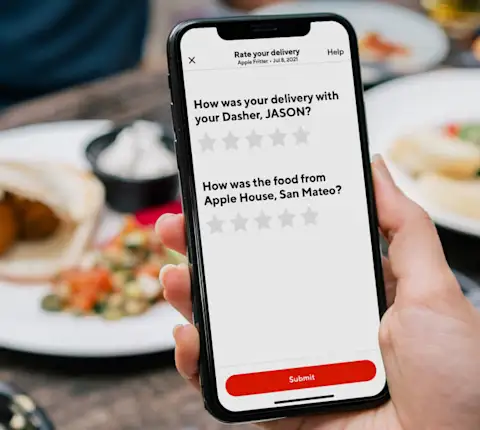
On a delivery app, you can't rely on ambiance or the in-person dining experience to build trust. Customer satisfaction has to be earned entirely through your digital presence, including your ratings, photos, reviews, and review responses, which are doing the work that a warm room and a good host normally would. The gap between a 4.2 and a 4.6 rating isn't just a vanity metric, it's order volume.
Respond to every review within 24 hours, positive or negative. It costs almost nothing and signals to every future customer reading your profile that you're attentive and that problems get resolved. Ask for reviews proactively: a card in the bag or a post-order SMS asking "How was it?" meaningfully lifts volume over time. Keep your photos current; a photo that no longer matches what arrives actively undermines trust. And watch your ratings dashboard weekly. A sudden dip almost always traces to a specific packaging or preparation issue. Catch it fast, before it compounds.
8. Audit your packaging for the unboxing experience
In 2026, delivery and takeout packaging is marketing. The moment a customer opens your bag determines whether they order again, leave a 5-star review, or post a photo to their Instagram stories, and it's one of the few touchpoints you fully control.
Quality packaging protects your food during the delivery journey. DoorDash has systems in place to ensure reliable delivery. Dashers are equipped with insulated bags and trained on food safety, but the packaging itself is your responsibility and your brand opportunity.
Packaging audit checklist:
Does your packaging maintain food temperature and freshness? (Check your Merchant Portal analytics for average delivery times in your area, typically 20-35 minutes)
Is your branding visible on the bag, the containers, or at minimum the sticker seal?
Are sauces, toppings, and dressings separated to prevent sogginess?
Is there a QR code inside the bag linking directly to your website or loyalty program?
That last point is one of the most practical conversion tools available: personalized QR codes that link directly to your own ordering page, designed in your brand. Every delivery bag becomes a customer acquisition touchpoint; one that costs nothing incremental once the packaging is already going out the door. Over time, even a small percentage of Marketplace customers converting to direct orders compounds into meaningful commission savings.
9. Use automated messaging for time-sensitive promotions
Automated SMS and email marketing campaigns, triggered by customer behaviour rather than sent manually, are among the most cost-effective tools for re-engaging existing customers. Just make sure customers have opted in first (CASL requires clear consent before you send automated texts or emails).
SMS in particular is exceptionally effective for time-sensitive delivery promotions, because a text lands on the lock screen instead of waiting in an inbox. A lunch special sent at 11 am reaches people while they're still deciding. A dinner push at 4 pm catches them before they've made plans.
A few sequences worth setting up: a lapsed customer offer for anyone who hasn't ordered in 21 days, a review request sent 30 minutes after estimated delivery, a birthday reward in the week of a customer's birthday, and a loyalty milestone notification when someone is close to a reward. Each trigger is based on real behaviour, not a calendar.
10. Partner with local Canadian businesses for cross-promotions
Building relationships with nearby businesses creates a consistent, high-volume revenue stream without the cost of traditional advertising.
How to make it work:
Target nearby offices and business parks. Offer exclusive delivery codes for employees at companies within your delivery radius. A 10% discount for "Company XYZ employees" creates word-of-mouth momentum and fills slower lunch periods with predictable volume.
Partner with hotels. Work with front desk staff to recommend your restaurant to guests. Provide special promo codes they can share, and consider offering a small commission or complimentary meals for hotel staff.
Collaborate with complementary businesses. Team up with local gyms (healthy meal options), coffee shops (lunch specials), or event venues (catering partnerships). Cross-promote each other on social media and in-store signage.
Create employee meal programs. Approach HR departments at local companies about setting up a regular lunch delivery program. Consistent bulk orders at a slight discount give you predictable revenue and introduce your food to potential individual customers.
Make it easy to share. Provide partners with unique promo codes they can track, so both of you can see what's working.
More ideas to increase restaurant sales through better operations
The 10 strategies above drive demand. What follows is what makes sure your restaurant can actually fulfill it. Most restaurants would see better results from tightening their operations than from spending more on acquisition. A bad experience doesn't just lose one customer; it impacts your ratings, which impacts your visibility, which impacts every future customer who would have found you.
A few things worth doing right now:
Keep your Google Business Profile and delivery platform listings accurate: inconsistent information (wrong hours, outdated menu items, incorrect phone numbers) suppresses your visibility when people are ordering food online, and it's an easy fix.
Run a quarterly menu audit and cut items that add complexity without adding revenue: a focused menu executes faster at peak windows and is easier to navigate on a phone screen.
Track your new-to-repeat customer ratio: if fewer than 30% of new customers order a second time, your retention strategy needs attention before you put more budget into acquisition.
Make sure every platform you use feeds from a single source of truth: menu updates that don’t require manual changes on separate screens (this is what POS integration solves).
Treat delivery as its own operational discipline: packaging accuracy, catching modifiers and notes, and courier handoff timing each affect your ratings in ways that general onboarding never addresses.
Grow your delivery sales with DoorDash Marketplace
DoorDash Marketplace puts you in front of millions of customers who are already ordering. Use Promotions to drive first orders and bring back lapsed customers. Add high-quality photos to increase conversion rates. Turn on commission-free Pickup to keep more of what you earn.
The restaurants growing fastest in 2026 aren't relying on a single channel, they're using Marketplace to get discovered, then giving customers multiple ways to come back.
New to DoorDash? Get started with Marketplace and start reaching new customers today. Get Started.
Already on Marketplace? Explore tools like Promotions, Sponsored Listings, and Pickup to increase orders without increasing costs.
Frequently asked questions
How do I get more delivery orders on DoorDash in Canada?
Complete your listing with accurate hours, high-quality menu photos, and detailed item descriptions. Respond to reviews within 24 hours. Run a first-order promotion to attract new customers.
What is the average delivery sales percentage for restaurants in Canada?
It varies enough by segment, market, and how optimized your channels are that there isn't one benchmark worth planning around. What the data does point to is where the volume comes from. In Canada, 45% of consumers place repeat orders at least every two weeks (2025 Delivery Trends Report, Canadian consumer data), and DoorDash's 2026 Restaurant Industry Trends Report (U.S. consumers only) found that 79% of orders go to restaurants customers have ordered from before. Either way you cut it, retention is as important as acquisition.
Either way you cut it, retention is as important as acquisition.
How do I increase delivery sales in Canada?
Start with your menu. Most of the lift comes from better photos, clearer descriptions, and smart item placement. Make sure your Marketplace listing is optimized for discovery. Add automated upsells to increase average order value without adding labour. And if you're not actively working to turn first-time delivery customers into repeat buyers, that's probably your single biggest opportunity.
What are the two main ways to increase sales in your Canadian restaurant?
Acquisition and retention. New customers come through discovery platforms, promotions, and local marketing. Repeat business comes from loyalty programs, personalized outreach, and consistently great experiences. The restaurants growing fastest treat them as one system; Marketplace handles acquisition, retention tools handle repeat orders.
How do I increase the average order value at my restaurant in Canada?
Automated upsells at checkout are the most direct lever, triggered suggestions based on what's already in the cart typically lift ticket size by 3% or more. Bundle pricing ("Add a side and drink for $4 more") tends to outperform offering add-ons individually. And high-margin items placed prominently in your menu do a lot of the work before checkout even happens.