Why Restaurant Customer Feedback Matters
Start with the money, not the warm feelings. Researchers at Harvard Business School found that a one-star increase on Yelp correlates with a 5 to 9% jump in restaurant revenue. For an independent spot, that swing is bigger than for a national chain, since a single local rating carries more weight.
Responding is where the real return shows– and it’s one of the lowest hanging fruits. Businesses that reply to at least 25% of their reviews average 35% more revenue than those that ignore them. Collecting customer feedback is one of the highest-return things a busy operator can do. If you run a small dining room and worry about your online reputation but never quite get around to managing it, this is your signal.
One newer player in the mix is worth watching. Roughly 22% of consumers have already used an AI tool like ChatGPT or Google Gemini to help choose where to eat. As people lean on these tools to compare nearby options by cuisine, occasion, or value, the reviews you have already collected become the raw material those systems read.
What Makes Feedback Actually Useful
Not every comment helps you. Useful feedback is specific. "It was fine" tells you nothing you can act on, while "the fries arrived cold and the wait was 40 minutes" tells you exactly what to tackle.
Recency matters too. A review from last year describes a kitchen and a crew that may not work for you anymore, and both diners and search algorithms place less importance on older reviews. A steady trickle of recent guest feedback beats a big pile of stale praise.
Channel shapes honesty. Feedback given to a server's face tends to skew polite, because few people want to complain to someone in person. Delivery feedback left later reflects real post-experience sentiment, which is why the DoorDash Merchant Portal (covered below) often surfaces candid notes your dining room never hears. Treat the eight methods below as a diversified strategy, since the blind spots in one channel are covered by another.
Great Restaurant Feedback Questions
Generic forms with vague questions produce vague answers, so it pays to design a form that draws out meaningful detail without burying guests under a dozen prompts. Five questions cover nearly everything an independent operator needs to know:
How would you rate your overall experience, from 1 to 5?
What is one thing we did well today?
What is one thing we could have done better?
How was the food quality and, for delivery, the temperature on arrival?
How likely are you to order from us again?
The first gives you a number to track. The middle three add the context behind it. The last measures loyalty, the metric that predicts repeat business.
8 Ways to Collect Restaurant Customer Feedback
The methods below span both dine-in and delivery, since most independent restaurants now run across both. The strongest operators rarely lean on a single source; they keep at least three or four of these running at once so feedback arrives from every direction.
1. Claim and Optimize Your Business Listings
Your listings on Google, Yelp, TripAdvisor, and OpenTable are where most people meet you first, and where most reviews land. Claim each one, then make sure your hours, menu, photos, and contact information are correct and consistent across all of them. A wrong phone number or an outdated menu sends guests straight to a competitor.
This is the foundation for everything else. 81% of consumers check Google reviews before visiting a business, so an accurate, complete listing is the prerequisite for any feedback strategy. Set your Google Business Profile (GBP) up properly, and the rest of the methods here have somewhere to point.
2. Encourage Online Reviews — Then Respond to Every One
People will leave reviews if you ask. In fact, 68% of consumers have left a review for a local business after being asked to do so. Train staff to mention it, add a line to receipts, and make the ask a part of the normal close of a visit. Getting more restaurant reviews is mostly a matter of remembering to ask, and there is more on that in our guide to getting restaurant reviews.
Then reply to all of them, especially the unhappy ones. Responding to a 1- or 2-star review within 24 hours gives you a 33% higher chance of the reviewer upgrading their rating, sometimes by as much as three stars. A fast, human reply turns a bad moment into a second chance at a client becoming a regular.
You can build a simple workflow around this. When a guest fills out your feedback form with a strong rating, send them straight to a direct review link for your GBP, with a suggested review drafted from their own answers so posting takes seconds. Route guests who left a low rating into a different path, one that thanks them and opens up a private conversation instead.
3. Build a Social Media Community That Talks Back
Social media is where a lot of unsolicited opinions live. Reply to comments, ask questions in your captions, thank people who tag you, and you turn a broadcast channel into a conversation. A lively comment section tells you what is working and what is not.
Keep this in perspective: social media is a passive collection tool. It catches feedback from customers who already felt moved to volunteer it, which skews toward your biggest fans and your angriest critics. It is worth doing, but don’t let it supersede the active methods below that reach the quiet middle.
4. Add Feedback Prompts to Receipts and Order Packaging
The receipt is prime real estate. A short note with a QR (quick response) code pointing to a one-question survey or a review page meets guests in the moment they are deciding how they felt. QR codes cost nothing to add and turn a scrap of paper into a feedback channel.
The same logic extends to delivery. A small insert card with a QR code takes about 60 seconds to design and can lift response rates sharply from delivery customers who would otherwise leave nothing at all. Print a stack, drop one in every bag, and you start hearing from a group that is usually silent.

5. Send Restaurant Feedback Form by Email or SMS
A direct survey reaches guests after they have left, when they can reflect. Match the channel to the length: use email for a slightly longer restaurant feedback form, and use SMS for a single post-visit rating question, since text messages get opened far more often than email. Whichever you pick, keep it to three to five questions so that people actually finish.
Timing influences response rates. Send within one to two hours after a delivery order, while the meal is still fresh in memory, and you will hear back more often and with greater detail. Wait a day and the moment, along with the specifics, is gone.
To accomplish this tip, you'll need a way to send emails and text messages to your customers. DoorDash Commerce Platform, our set of tools built to help you grow online orders, includes customizable email and text marketing, so you can send messages to your customers at exactly the right time.
6. Collect In-Person Feedback at the Table or Counter
For a dining room, the mid-meal check-back is your best listening post. Train your waiting staff to stop by partway through the meal, not just after dessert, because most complaints form at the midpoint and quietly die there when nobody asks. A well-timed "how is everything so far?" catches a problem while you can still fix it.
A server who asks a question and listens is collecting data your review site will never show you. For a counter-service spot, a simple QR code at the register asking one question, "How was your visit?", pulls two to three times the response of a paper comment card. Whether you run a white-tablecloth room or a fast food window, the point is the same: ask while the guest is still standing in front of you.
7. Use the DoorDash Merchant Portal
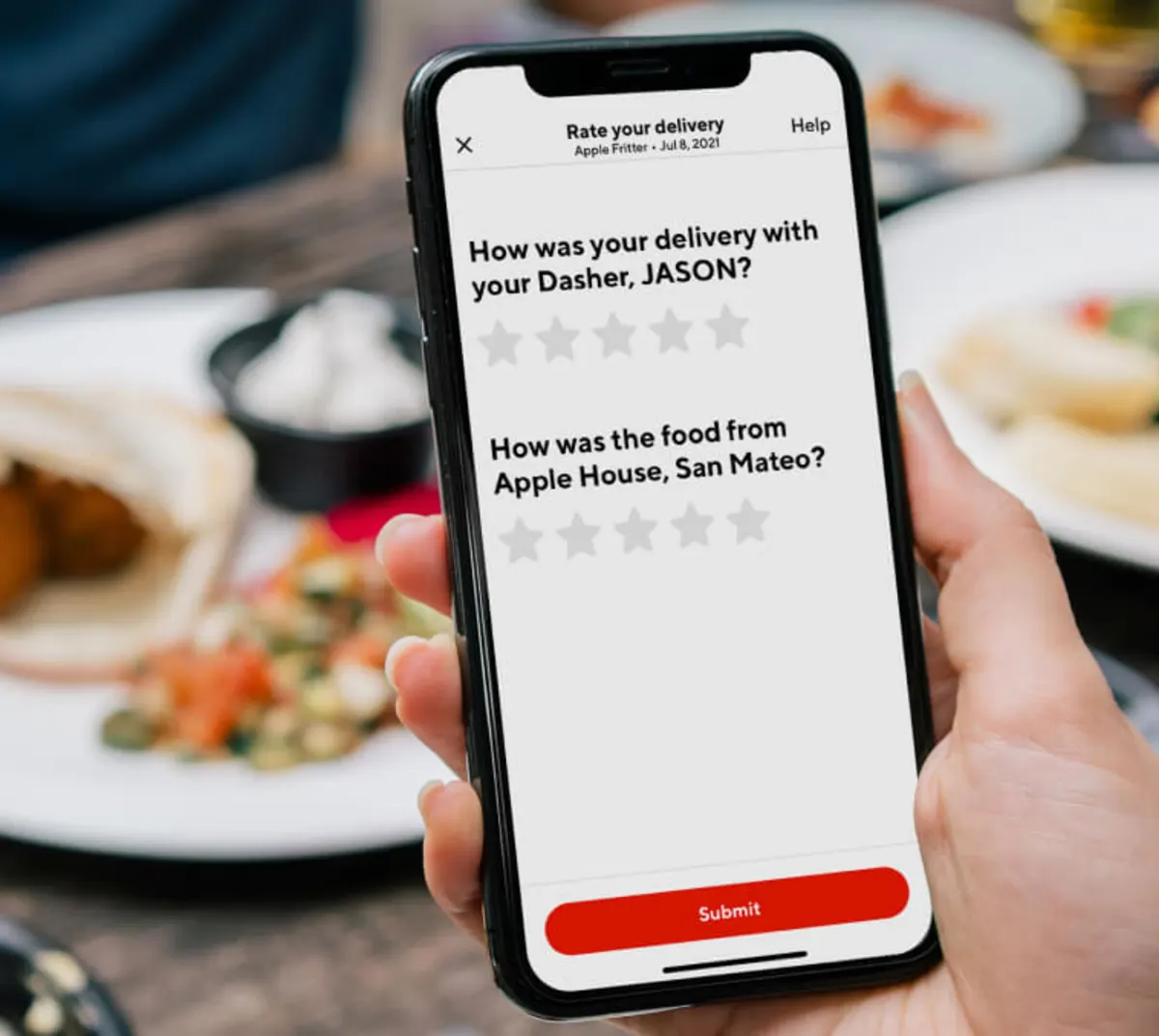
If you take delivery orders on DoorDash Marketplace, the Merchant Portal is one of your most candid feedback sources. It gives you private customer feedback on food quality, temperature, order accuracy, and menu clarity, the kind of detail that never shows up in a public star rating but tells you exactly what to fix.
You can respond to customers directly through the portal, using pre-built templates or a personalized message, and include a discount to bring a dissatisfied guest back. Keep in mind that you can only respond to DoorDash Marketplace reviews inside the Merchant Portal. Used well, it makes the difference between a bad delivery and a recovered customer, often at the crucial point before that guest thinks about posting publicly.
8. Use a Dedicated Guest Experience Tool
Here is the problem most independents hit: reviews pile up on Google, DoorDash and other third-party sites, causing feedback to slip through the cracks. Scattered feedback across platforms is a management problem, not just a technology one.
A dedicated tool pulls it into one place. Guest Experience Management, part of DoorDash Commerce Platform, consolidates review monitoring and response in a single dashboard, automatically prompts happy customers to leave reviews after a delivery order, and helps you catch and answer negative feedback before it snowballs. As with the rest of Commerce Platform, it is built for restaurants and requires an active DoorDash Marketplace account. Read more about guest experience management for restaurants and how it fits alongside your other channels.
Restaurant Survey Questions Worth Asking
You do not need a 60-question survey. A busy operator needs something guests will finish, so keep two short sets ready to go, one for each side of the business.
For dine-in guests, a 3-question post-visit survey: How would you rate your overall experience? What is one thing we did especially well? What is one thing we could improve? That covers a rating, a highlight, and a fix in under a minute.
For delivery customers, a 3-question post-order survey: Was your order accurate and complete? How was the temperature and food quality on arrival? How likely are you to order again?
The principle behind both is the same. Ask one rating question for a number you can track, one open-ended question for the story behind it, and one forward-looking question to gauge loyalty. That mix gives you data you can chart and quotes you can act on, without wearing out the guest with a lengthy set of questions.

How to Turn Customer Feedback Into Action
Collecting feedback is only half the job. What matters is how you use it.
Look for patterns, not one-offs. One complaint about a slow ticket is noise or a potential outlier. Five complaints about slow tickets in a single week is a signal. Read your feedback in batches and watch for the same note repeating, since that repetition is where the real problems live.
Prioritize by frequency and impact. Fix what is costing you the most orders first. Accuracy and temperature problems drive people away faster than a lukewarm opinion on your ambiance or the lighting, so handle the order-killers before the nice-to-haves.
Close the loop. When you change something because guests asked, tell them. A short social post or email that says "you asked, we listened, our new packaging keeps your fries hot all the way home" builds more customer loyalty than any coupon. It shows customers their input matters, which makes them far more likely to give it again.
Ready to Manage Every Piece of Customer Feedback in One Place?
Pulling feedback from the DoorDash Merchant Portal, Google, and your email surveys is a lot to juggle when you are also running a busy service, and a review can easily sit unanswered for a week.
If you already take orders on DoorDash Marketplace, Commerce Platform is the natural next step, since it is built for restaurants and works on top of your existing Marketplace account. Add Guest Experience Management to capture post-order feedback, prompt happy customers to leave public reviews, and respond to every review from one dashboard. You can also grow on your own direct channels with Commerce Platform so the guests Marketplace brings in become regulars who order straight from you. Commission-free direct ordering keeps more of each check in your pocket, though standard payment processing fees still apply.